(The following is a transcript from my weekly appearance on Hugh Hewitt's national radio show. Yours truly is a guest on Hugh's show every Friday night at 7:20pm ET. If you'd like to listen to the transcript from this past Friday's broadcast, click here.)
HH: This is rapidly becoming my favorite segment of the week, because Larry Kudlow cuts through the crap, and just gets to the bottom line when it comes to the economy. Larry Kudlow, interest rates on the 10 year dropped below 5%. The overnight is at 5 1/4. What's going on?
LK: Mortgage rates fell big. Mortgage rates are falling, I think, three or four consecutive weeks. Mortgage rates are falling. Energy prices are falling. Gasoline prices in the open market dropped under $2.00 to $1.95. If you add a buck for taxes and carrying charge, it tells you that across the nation, we're going to hit a $2.95 cent average gas price. That gets it below $3 bucks. NASDAQ tech stocks, Hugh, had their best week in four years. And the overall averages were all up. We are approaching, again, the highs, the five year highs, that were registered in early May. It is the greatest story never told, including the underlying economy, including the tax cuts, which George Bush talked about at Camp David today. It's a good story, and the cacophony of all these complaining, cults of the brear people is being put to rout.
HH: Let me talk to you a little bit, Larry Kudlow, about specific advice for people listening, and then get back to the macro. If you've got cash on the sidelines, and you want to park it in a mutual fund, where does Larry Kudlow tell you to look?
LK: You know, I always say buy the broad-based indexes. Buy the indexed fund for the S&P 500, buy the indexed fund for the Wilshire 5,000. You get all the major traded stocks in America. Essentially, you're buying a piece of the rock in this country's long-run economy. That's where they should go. If they're not professionals, believe me, you can't be picking and choosing, and buying and selling, and trading and day trading. Better off to buy the broadest indexes, and it's cheap. These index funds cost you about $.25 cents on the dollar. It is the best way to participate in this stock market, which by the way, is heating up, and it's going to bust through all the highs, you wait and see, by the end of this year, or early next.
HH: Now Larry, I always get questions, that say Hugh, I'm in the investor's class. I'm in an investment club. I want specifics from Larry Kudlow. And so, if they are doing the $100 dollars a month, and they're picking stocks because it's fun, what do you tell them to do?
LK: Well, that's an interesting question. That's a very interesting question. You know, when you look down the list, you see some very interesting things right now. You see, for example, some of the retailers, which have done very poorly, are having a nice little comeback, like this week, Circuit City was up 11%.
HH: Oh.
LK: Nordstroms was up 7%. Federated was up 4%. Even Amazon.com was up 4% this week. Now that stuff has been clobbered, and people have shunned it. I would go back to it. I'll tell you another one. Semiconductor companies...this week, AMD, which is kind of the new Intel, was up 21%. Broadcom was up 20%. Marvel Technologies was up 8%. Some of the communications companies...these are the equipment builders, because you know, the telephone companies are doing fiber optic buildouts to do internet telephony, and they're doing buildouts in order to get a piece of the television business. So what you're seeing...and the cable companies, by the way, are having to redo their own fiber optic stuff. So for example, this week, Qualcom was up 12%, and Lucent was up 9.5%. And Cisco was up 6.5%. And cell phone maker Motorola, I got my razor phone. You ought to have one, too. Motorola was up 5%. These are all very interesting little plays going on here.
HH: Hey, a programming suggestion for you, Larry.
LK: Now I'm not recommending. I'm just saying these are interesting plays. I am not the guy to recommend and pound the table. But since you asked, I'm just saying here's some hot stocks in some neglected sectors. Retail and computer chips, and communications equipment. Let me be very clear. I can't recommend them. I'm just saying this is stuff that looks like it has value.
HH: Programming for you, though. I think Larry Kudlow's stock club, that took the same kind of ethic that stock clubs around the country did on a Friday afternoon feature, would be enormously popular, because people do do this. And it's a good thing for the investor class to get together and talk about this. It's an educational process, for one thing.
LK: Well, I can only tell you that I think the growth-oriented sectors of the economy, and that...you know, let's take the consumer sector. Let's look at that for a minute. Everybody wrote the consumer off. They said the housing is slumping. That's going to kill consumers. Guess what? It hasn't. Consumers are very resilient. The great American consumer. Jobs are rising, unemployment is low, incomes are going up, tax rates are low. Consumers are showing a lot of resilience, and that's why I wouldn't write off all the consumer stocks. And incidentally, I wouldn't write off the home builders. Home builders have been smashed. Some of these great companies are down 50% for God's sakes. the home building correction is coming to an end. In fact, we saw in the 2nd quarter, home prices actually went up for a change. And while all the Wall Street consensus bears are telling you homes are getting killed, and are going to keep getting killed, if you have any contrarian blood in you, you might want to look at some of these home builders. I mean...
HH: Especially with interest rates on a glide path.
LK: Yes. Mortgage rates are coming down. For example, this week, Toll Brothers was up 5%, Lennar was up 5.5%. Pulte Homes was up 7%. Centex was up 8%. It's very interesting what's going on out there. It's counter-consensus.
HH: Now let me ask you to go macro again. Damage to the Israeli economy. How significant?
LK: Well, they got hurt. I don't know how significant it's going to be in the longer run. I'm not sure that there's going to be all that much. I mean, I hate to say it, but they are used to this kind of buffeting.
HH: Interesting.
LK: And I would also say that the Hezbollah rockets, they've fired a lot of rockets. I'm not sure what all damage they did. I mean, they did kill some people, some families are hurt, and they had to move out. But in terms of the Israeli...you know, the Israeli economy is a technology driven economy. It's a near cousin to the NASDAQ. So it kind of trades off of the NASDAQ, and it's been in a slump just like the NASDAQ has been, but when you see the NASDAQ go up, really, to the best week in four years, and it may be that there's a revival in tech stocks, you might want to take a look at that.
HH: Thirty seconds, Larry. What about the defense industry? It's been a strong sector for a long time.
LK: Fabulous. Absolutely fabulous the last five years, up about 260%. The world is a dangerous place. I don't care who's running Congress. Military budgets are going to continue to expand. I love the defense companies. I just love them. And by the way, they're all better managed, and they apply good technology, and they're very productive. I would buy them across the board. I love defense stocks. Love them.
HH: Larry Kudlow, think about that Larry Kudlow stock club. It's a winner on Friday afternoon. I'll keep it up here. Larry, talk to you next week.
End of interview.
Wednesday, August 23, 2006
Tuesday, August 22, 2006
The Threat We Face
(An excerpt from Thomas Sowell's literary wake-up call, "Point of No Return," available in its entirety on RealClearPolitics.)
"...What kind of people provide a market for videotaped beheadings of innocent hostages? What kind of people would throw an old man in a wheelchair off a cruise liner into the sea, simply because he was Jewish? What kind of people would fly planes into buildings to vent their hate at the cost of their own lives?
These are the kinds of people we are talking about getting nuclear weapons. And what of ourselves?
Do we understand that the world will never be the same after hate-filled fanatics gain the ability to wipe whole American cities off the face of the earth? Do we still imagine that they can be bought off, as Israel was urged to buy them off with "land for peace" -- a peace that has proved to be wholly illusory?
Even ruthless conquerors of the past, from Genghis Khan to Adolf Hitler, wanted some tangible gains for themselves or their nations -- land, wealth, dominion. What Middle East fanatics want is the destruction and humiliation of the west.
Their treatment of hostages, some of whom have been humanitarians serving the people of the Middle East, shows that what the terrorists want is to inflict the maximum pain and psychic anguish on their victims before killing them.
Once these fanatics have nuclear weapons, those victims can include you, your children and your children's children.
The terrorists need not start out by wiping our cities off the map. Chances are they would first want to force us to humiliate ourselves in whatever ways their sadistic imaginations could conceive, out of fear of their nuclear weapons.
After we, or our children and grandchildren, find ourselves living at the mercy of people with no mercy, what will future generations think of us, that we let this happen because we wanted to placate "world opinion" by not acting "unilaterally"?
We are fast approaching the point of no return."
"...What kind of people provide a market for videotaped beheadings of innocent hostages? What kind of people would throw an old man in a wheelchair off a cruise liner into the sea, simply because he was Jewish? What kind of people would fly planes into buildings to vent their hate at the cost of their own lives?
These are the kinds of people we are talking about getting nuclear weapons. And what of ourselves?
Do we understand that the world will never be the same after hate-filled fanatics gain the ability to wipe whole American cities off the face of the earth? Do we still imagine that they can be bought off, as Israel was urged to buy them off with "land for peace" -- a peace that has proved to be wholly illusory?
Even ruthless conquerors of the past, from Genghis Khan to Adolf Hitler, wanted some tangible gains for themselves or their nations -- land, wealth, dominion. What Middle East fanatics want is the destruction and humiliation of the west.
Their treatment of hostages, some of whom have been humanitarians serving the people of the Middle East, shows that what the terrorists want is to inflict the maximum pain and psychic anguish on their victims before killing them.
Once these fanatics have nuclear weapons, those victims can include you, your children and your children's children.
The terrorists need not start out by wiping our cities off the map. Chances are they would first want to force us to humiliate ourselves in whatever ways their sadistic imaginations could conceive, out of fear of their nuclear weapons.
After we, or our children and grandchildren, find ourselves living at the mercy of people with no mercy, what will future generations think of us, that we let this happen because we wanted to placate "world opinion" by not acting "unilaterally"?
We are fast approaching the point of no return."


Tonight's Lineup
 On CNBC's Kudlow & Company this evening:
The Great Rate Debate between Michelle Girard, senior economist at RBS Greenwich Capital Management and David Goldman, Global Head of Fixed Income Research.
The inaugural edition of The Kudlow Stock Club. Keith Wirtz, President & CIO of Fifth Third Asset Management and Frank Holmes, CEO/CIO of US Global Investors will present and defend their latest stock picks.
An economic discussion with Laura Tyson, Dean of the London Business School and David Malpass, Chief Global Economist of Bear Stearns.
A political discussion with Tony Blankley of the Washington Times; former House Majority Leader Dick Armey; Larry O'Donnell, MSNBC Senior Political Analyst; and Dan Gernstein, Sen. Lieberman's communications director.
No Doomsday Yet
Although there are still a few more hours left in the day, the Islamic doomsday scenario scheduled for today, August 22, appears not to be in place. Maybe the airplane bombing terrorist threat foiled by our British cousins at MI5 and Scotland Yard was aimed at the doomsday scenario. We will always be thankful for the Brits.
But the big Internet story in recent days was the potential significance of August 22nd as a possible target date for a massive terrorist attack commemorating the return of the 12th Imam; a supposed day of reckoning for Shiites who believe that August 22nd corresponds to the end of the world.
Stock market investors were wearily eyeing the top of yesterday’s Drudge Report which featured this story. But veteran portfolio manager Mike Holland told us on Kudlow and Company last night that he didn’t believe a word of it. Blessedly, Mr. Holland looks to have gotten it right.
Stocks have been rising in recent weeks on the strength of a stronger than expected American economy, where resilient consumers and highly profitable businesses are outperforming the doom & gloom, cacophonous, cult of the bear on Wall Street.
Within shouting distance of 5-year highs, the bull market economy and stocks, backed by President Bush’s successful low tax rate program, continues to outperform the bearish consensus. It is the greatest story never told. It continues to dodge doomsday.
And then we have President Bush, under fire from both the left and the right, who very clearly communicated a strong positive vision for the upcoming congressional elections during yesterday’s news conference. Bush is attempting to take command of the election year Republican strategy to avoid a doomsday scenario this November.
He said, “Look, issues are won based on whether or not you can keep this economy strong—elections are won based on economic issues and national security issues…I'd be telling people that the Democrats will raise your taxes…I’d be running on the economy and I’d be running on national security. But since I’m not running, I can only serve as an advisor to those who are.”
The latest Gallup Poll shows Bush’s approval now at 42 percent, up from 31 percent in May. But here’s the real anti-doomsday shocker: among registered voters, the Republicans have closed a 12-point deficit on the generic congressional ballot in early last June to only 2 percentage points now, with the Dems at 47 percent and the Republicans at 45.
It may well be that the “Armageddon Imams” are actually helping the down on their luck GOP.
With terrorism on the front page, Democrats are losing ground rapidly, almost as much ground lost as the Boston Red Sox, who just got slammed for five straight games by the New York Yankees. Now that’s doomsday.
As for the rest of this story, I say keep the faith. Faith is the spirit.
But the big Internet story in recent days was the potential significance of August 22nd as a possible target date for a massive terrorist attack commemorating the return of the 12th Imam; a supposed day of reckoning for Shiites who believe that August 22nd corresponds to the end of the world.
Stock market investors were wearily eyeing the top of yesterday’s Drudge Report which featured this story. But veteran portfolio manager Mike Holland told us on Kudlow and Company last night that he didn’t believe a word of it. Blessedly, Mr. Holland looks to have gotten it right.
Stocks have been rising in recent weeks on the strength of a stronger than expected American economy, where resilient consumers and highly profitable businesses are outperforming the doom & gloom, cacophonous, cult of the bear on Wall Street.
Within shouting distance of 5-year highs, the bull market economy and stocks, backed by President Bush’s successful low tax rate program, continues to outperform the bearish consensus. It is the greatest story never told. It continues to dodge doomsday.
And then we have President Bush, under fire from both the left and the right, who very clearly communicated a strong positive vision for the upcoming congressional elections during yesterday’s news conference. Bush is attempting to take command of the election year Republican strategy to avoid a doomsday scenario this November.
He said, “Look, issues are won based on whether or not you can keep this economy strong—elections are won based on economic issues and national security issues…I'd be telling people that the Democrats will raise your taxes…I’d be running on the economy and I’d be running on national security. But since I’m not running, I can only serve as an advisor to those who are.”
The latest Gallup Poll shows Bush’s approval now at 42 percent, up from 31 percent in May. But here’s the real anti-doomsday shocker: among registered voters, the Republicans have closed a 12-point deficit on the generic congressional ballot in early last June to only 2 percentage points now, with the Dems at 47 percent and the Republicans at 45.
It may well be that the “Armageddon Imams” are actually helping the down on their luck GOP.
With terrorism on the front page, Democrats are losing ground rapidly, almost as much ground lost as the Boston Red Sox, who just got slammed for five straight games by the New York Yankees. Now that’s doomsday.
As for the rest of this story, I say keep the faith. Faith is the spirit.
Come Out, Come Out, Wherever You Are!
Looks like Instapundit's Glenn Reynolds is ruffling feathers again on Capitol Hill.
Here's the background from The Wall Street Journal:
"There's a desperate new manhunt across the country, and the suspects are no less than 91 Members of the world's greatest deliberative body. One of these Senators has a big secret, and we should all have some fun as the foes of government pork try to run the mystery politician to ground.
Here's the forensic background: In April, Oklahoma Senator Tom Coburn introduced legislation that would set-up a database to track an estimated $1 trillion in federal grants, earmarks, contracts and loans. Americans would be able to perform Google-like searches to track how their tax dollars are spent -- or frittered away, as the case might be. Twenty-nine Senators have co-sponsored the bill, and it's a testament to how concerned some are about Washington's miserable spending reputation that the list includes a who's who of Presidential hopefuls, from Hillary Rodham Clinton to George Allen to Bill Frist.
Yet most Senators clearly have no desire to shine a light on their spending practices, and at least one -- perhaps more -- has placed a "secret" hold on the legislation. Normally the architects of these holds are exposed within a few legislative days, but with Congress on recess the masked spender has so far evaded capture and public scrutiny.
Porkbusters, a grassroots outfit that fights government waste, found this untransparent move to stymie government transparency a bit rich, and last week launched a campaign to unveil the blocker's identity. It has asked its members to call on their Senators to disavow the hold, and the responses are trickling in. The group, which is tracking the results on its Web site (www.porkbusters.org), still has the pictures of 91 Senators under its "Suspect" list. The nine Senators who have denied placing the hold are now listed as "In the Clear"; they are Senator Coburn, Barack Obama, Mary Landrieu, David Vitter, John McCain, Ron Wyden, Richard Shelby, Jim Inhofe and Jeff Sessions.
If Congress insists on spending like there's no tomorrow, at least the Members could let the voters see what they're spending it on by passing Senator Coburn's reform. Will the real secret Senator please stand up?"
A tip of the hat to you Glenn...
Here's the background from The Wall Street Journal:
"There's a desperate new manhunt across the country, and the suspects are no less than 91 Members of the world's greatest deliberative body. One of these Senators has a big secret, and we should all have some fun as the foes of government pork try to run the mystery politician to ground.
Here's the forensic background: In April, Oklahoma Senator Tom Coburn introduced legislation that would set-up a database to track an estimated $1 trillion in federal grants, earmarks, contracts and loans. Americans would be able to perform Google-like searches to track how their tax dollars are spent -- or frittered away, as the case might be. Twenty-nine Senators have co-sponsored the bill, and it's a testament to how concerned some are about Washington's miserable spending reputation that the list includes a who's who of Presidential hopefuls, from Hillary Rodham Clinton to George Allen to Bill Frist.
Yet most Senators clearly have no desire to shine a light on their spending practices, and at least one -- perhaps more -- has placed a "secret" hold on the legislation. Normally the architects of these holds are exposed within a few legislative days, but with Congress on recess the masked spender has so far evaded capture and public scrutiny.
Porkbusters, a grassroots outfit that fights government waste, found this untransparent move to stymie government transparency a bit rich, and last week launched a campaign to unveil the blocker's identity. It has asked its members to call on their Senators to disavow the hold, and the responses are trickling in. The group, which is tracking the results on its Web site (www.porkbusters.org), still has the pictures of 91 Senators under its "Suspect" list. The nine Senators who have denied placing the hold are now listed as "In the Clear"; they are Senator Coburn, Barack Obama, Mary Landrieu, David Vitter, John McCain, Ron Wyden, Richard Shelby, Jim Inhofe and Jeff Sessions.
If Congress insists on spending like there's no tomorrow, at least the Members could let the voters see what they're spending it on by passing Senator Coburn's reform. Will the real secret Senator please stand up?"
A tip of the hat to you Glenn...
Monday, August 21, 2006
Israel vs. Hezbollah: The Markets React
(From the National Review Online.)
A Vote for Civilization in the Middle East
Tracking Arab large-caps through the Israel-Hezbollah crisis.
By Jerry Bowyer
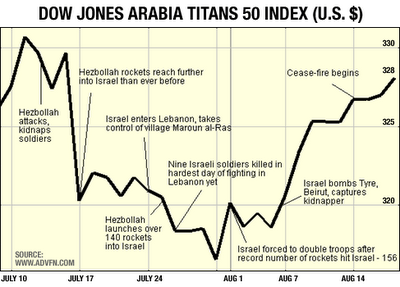 After the battle for southern Lebanon ended, the battle to dominate the global post-war spin room immediately began. Pundits are fine, but when BuzzCharts really wants to know whether a region is moving towards chaos or towards civilization, it looks to the marketplace. Reporters can poll the “Arab street” all they want, but to find out what the locals really believe, you have to watch one of the most powerful ballots a man can cast — his nest egg.
By that measure, the Israel-Hezbollah crisis of 2006 yields some surprising results. BuzzCharts looked at an index of 50 large publicly traded companies which do business in the Arab world, mostly banks and utilities. We then synced it with the timeline of the conflict, marking out major advances and setbacks in Israel’s war against Hezbollah.
You probably won’t be surprised to learn that the Israeli stock exchange rallied and fell in step with Israel’s fortunes in the war. But as the above chart shows, the Arab Titans index did the same, rising and falling in step with Israel’s success. Why? Because Israel’s counter-attacks were not the destabilizing factor in the region. Hezbollah’s failed-state warlordism was.
Israel’s attack was part of the solution. That’s because the conflict isn’t between Arab and Jew; it’s between civilization and chaos. The complex web of information that constitutes Saudi bankers, Kuwaiti phone execs, and their shareholders seems to have been voting that civilization is either winning, or that it must win.
A Vote for Civilization in the Middle East
Tracking Arab large-caps through the Israel-Hezbollah crisis.
By Jerry Bowyer
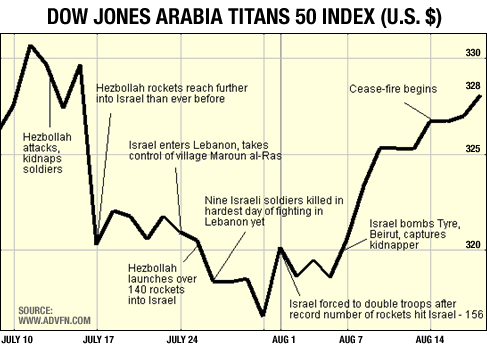 After the battle for southern Lebanon ended, the battle to dominate the global post-war spin room immediately began. Pundits are fine, but when BuzzCharts really wants to know whether a region is moving towards chaos or towards civilization, it looks to the marketplace. Reporters can poll the “Arab street” all they want, but to find out what the locals really believe, you have to watch one of the most powerful ballots a man can cast — his nest egg.
By that measure, the Israel-Hezbollah crisis of 2006 yields some surprising results. BuzzCharts looked at an index of 50 large publicly traded companies which do business in the Arab world, mostly banks and utilities. We then synced it with the timeline of the conflict, marking out major advances and setbacks in Israel’s war against Hezbollah.
You probably won’t be surprised to learn that the Israeli stock exchange rallied and fell in step with Israel’s fortunes in the war. But as the above chart shows, the Arab Titans index did the same, rising and falling in step with Israel’s success. Why? Because Israel’s counter-attacks were not the destabilizing factor in the region. Hezbollah’s failed-state warlordism was.
Israel’s attack was part of the solution. That’s because the conflict isn’t between Arab and Jew; it’s between civilization and chaos. The complex web of information that constitutes Saudi bankers, Kuwaiti phone execs, and their shareholders seems to have been voting that civilization is either winning, or that it must win.
Lieberman and Iraq
As I predicted, Lieberman has become increasingly critical of President Bush’s war management polices. Yesterday, on CBS’s “Face the Nation”, Lieberman called for Defense Secretary Rumsfeld’s resignation and he criticized the Bush administration for not having sent more troops into Iraq.
The Lamont campaign then attacked Lieberman by saying, “his new found criticism of war won’t convince Connecticut voters after so many years of stubbornly rubberstamping Bush’s failed policies.”
Looks to me like the big difference on war between Lieberman and Lamont is that Lamont favors a one year deadline troop withdrawal (as he said on Kudlow & Company last week) whereas Lieberman does not favor a deadline.
So, pro-war hawks like myself would favor Lieberman. But of course the big problem I have is that the U.S. is not winning the war. Staying the course doesn’t sound like a solution to the massive sectarian violence going on in Iraq.
On domestic policies, they’re both liberal democrats opposing tax cuts, ANWR and offshore drilling, and opposing the ban on partial birth abortion.
Lamont however may be slightly to the right of Lieberman on budget spending. In the CNBC interview with me, Lamont said he wanted to eliminate budget earmarks like the abusive transportation bill. Lieberman is a defender of earmarks.
Incidentally, Sen. John Kerry on ABC’s “This Week with George Stephanopoulos”, blasted Lieberman and called him the new Cheney. OOOooooooo! But I know Dick Cheney, have known him for many years, and Joe Lieberman, you’re no Dick Cheney.
The Lamont campaign then attacked Lieberman by saying, “his new found criticism of war won’t convince Connecticut voters after so many years of stubbornly rubberstamping Bush’s failed policies.”
Looks to me like the big difference on war between Lieberman and Lamont is that Lamont favors a one year deadline troop withdrawal (as he said on Kudlow & Company last week) whereas Lieberman does not favor a deadline.
So, pro-war hawks like myself would favor Lieberman. But of course the big problem I have is that the U.S. is not winning the war. Staying the course doesn’t sound like a solution to the massive sectarian violence going on in Iraq.
On domestic policies, they’re both liberal democrats opposing tax cuts, ANWR and offshore drilling, and opposing the ban on partial birth abortion.
Lamont however may be slightly to the right of Lieberman on budget spending. In the CNBC interview with me, Lamont said he wanted to eliminate budget earmarks like the abusive transportation bill. Lieberman is a defender of earmarks.
Incidentally, Sen. John Kerry on ABC’s “This Week with George Stephanopoulos”, blasted Lieberman and called him the new Cheney. OOOooooooo! But I know Dick Cheney, have known him for many years, and Joe Lieberman, you’re no Dick Cheney.
Friday, August 18, 2006
Huh?
 Does the Congressional Budget Office truly believe that higher tax rates over the next ten years will expand economic growth and lower the budget deficit? This forecast of theirs simply defies economic common sense.
 If that were the case, then why not raise tax rates across the board back to 70 percent, where Reagan found them, or even 91 percent, where JFK inherited them?
If it pays less to work and invest, after tax, as implied by the CBO, does anyone really believe people would work harder?
Over then next ten years, the budget agency expects 2.8 percent annual growth, when in fact over the past 50 years, growth has averaged 3.5 percent. What's more, rapid growth over the past 25 years with lower tax rates has greatly boosted this 50-year average.
So the idea that higher tax rates might balance the budget, or that an extension of lower tax rates will generate a $1.7 trillion higher deficit, just makes no sense at all.
Mainstream economists today believe that tax incentives matter. All but the farthest left economists like Paul Krugman and his ilk believe that economic behavior is highly responsive to changing tax rates. The CBO is telling us otherwise and it just doesn’t figure.
Of course, these long term economic and budget projections remind us of Friedrich Hayek’s fatal conceit. That is, government planners can accurately predict the future. I don’t think so. Consequently, with all due respect to the professionals at CBO, I just don’t buy into their new numbers.
Perhaps they should focus more clearly on the here and now. What’s happened in recent years following the Bush tax cuts is a stronger economy, much higher tax revenue collection, and continuous downward estimates of the budget gap.
This is the real story.
Tonight's Lineup
 On CNBC's "Kudlow & Company" tonight:
We'll begin with a look into what's ahead following Bush's meeting with his economic team.
Al Hubbard, National Economic Council Director will join us from the White House.
On board to weigh in after our interview with Mr. Hubbard will be renowned economist Art Laffer and Robert Reich, former Clinton Labor Secretary and economics professor at UC Berkley.
The CBO's acting director, Donald Marron, will join us to discuss the deficit.
Conservative columist Ann Coulter will square off against liberal author Peter Beinart on a number of hot issues including profiling, wiretapping and national security.
Jeff Kleintop, chief investment strategist of PNC Wealth Management, will discuss domestic and international markets.
Profiling Works
(The following is an excerpt from last night's heated discussion on "Kudlow & Company" where we discussed profiling potential terrorists. My guests were Ibrahim Hooper, the spokeman for the Council on American-Islamic Relations (CAIR) and Jed Babbin, author/former deputy undersecretary of defense.)
KUDLOW: All right, gentlemen. Let me move quickly to another but very important subject, the front page of the New York Times. An excellent story by Mr. Eric Lipton. Let me just read briefly. "As the man approached the airport security checkpoint here on Wednesday, he kept picking up and putting down his backpack, touching his fingers to his chin, rubbing some object in his hands and finally reaching for a pack of cigarettes even though smoking was not allowed. Two transportation security administration officers stood nearby, nearly motionless and silent, gazing straight at him, then with a nod they moved in, chatted briefly, and then swiftly pulled him aside." Now, this is called behavioral--this is called behavioral profiling...Jed Babbin, what is your take on this new development? They're using it in London. They're using it in Israel, Tel Aviv and so forth, and it looks like they're using it in the United States increasingly.
Mr. BABBIN: Well look, it's not new. It's been used by the Israelis for three decades very successfully. And what we're talking about here, Larry, this is not a civil rights issue. Nobody's going to confuse Ibrahim with Martin Luther King Jr., or confuse CAIR with the NAACP. We're talking about profiling of people who are more likely to be terrorists. And if you look at the list of the 24 people arrested in London, you don't see any Johanssens or Kowalskis or Goldfarbs or O'Flanagans on that. It's all those people.
Mr. HOOPER: Can you be more racist?
Mr. BABBIN: Well, I don't think I--that's not racist. This is not about racism.
Mr. HOOPER: OK, I'll ask you...
Mr. BABBIN: If you read the Con--look, I will...
Mr. HOOPER: How would you determine who is a Muslim to be profiled? Would you pull me aside? I didn't wear my skull cap just so that you...
Mr. BABBIN: Oh, I certainly would. I would absolutely. Ibrahim, you'd be at the top of my list because CAIR's history...
Mr. HOOPER: How would you know I was a Muslim?
Mr. BABBIN: Because I know you--look...
Mr. HOOPER: How would you know I was a Muslim?
Mr. BABBIN: It's not a question of knowing who is a Muslim or who is not. We know people who have certain appearances, we know people who have certain behavior patterns. This behavior profiling has been working for 30 years.
KUDLOW: All right, gentlemen. Let me move quickly to another but very important subject, the front page of the New York Times. An excellent story by Mr. Eric Lipton. Let me just read briefly. "As the man approached the airport security checkpoint here on Wednesday, he kept picking up and putting down his backpack, touching his fingers to his chin, rubbing some object in his hands and finally reaching for a pack of cigarettes even though smoking was not allowed. Two transportation security administration officers stood nearby, nearly motionless and silent, gazing straight at him, then with a nod they moved in, chatted briefly, and then swiftly pulled him aside." Now, this is called behavioral--this is called behavioral profiling...Jed Babbin, what is your take on this new development? They're using it in London. They're using it in Israel, Tel Aviv and so forth, and it looks like they're using it in the United States increasingly.
Mr. BABBIN: Well look, it's not new. It's been used by the Israelis for three decades very successfully. And what we're talking about here, Larry, this is not a civil rights issue. Nobody's going to confuse Ibrahim with Martin Luther King Jr., or confuse CAIR with the NAACP. We're talking about profiling of people who are more likely to be terrorists. And if you look at the list of the 24 people arrested in London, you don't see any Johanssens or Kowalskis or Goldfarbs or O'Flanagans on that. It's all those people.
Mr. HOOPER: Can you be more racist?
Mr. BABBIN: Well, I don't think I--that's not racist. This is not about racism.
Mr. HOOPER: OK, I'll ask you...
Mr. BABBIN: If you read the Con--look, I will...
Mr. HOOPER: How would you determine who is a Muslim to be profiled? Would you pull me aside? I didn't wear my skull cap just so that you...
Mr. BABBIN: Oh, I certainly would. I would absolutely. Ibrahim, you'd be at the top of my list because CAIR's history...
Mr. HOOPER: How would you know I was a Muslim?
Mr. BABBIN: Because I know you--look...
Mr. HOOPER: How would you know I was a Muslim?
Mr. BABBIN: It's not a question of knowing who is a Muslim or who is not. We know people who have certain appearances, we know people who have certain behavior patterns. This behavior profiling has been working for 30 years.
"Go West, Young Man..."
 There’s a wonderful piece in The Wall Street Journal today about how Canada’s western provinces are cutting tax rates and growing rapidly. The combination of supply-side tax cuts, free trade, and the oil sands boom has created quite the economic boom up there.
 You couldn’t have a bigger contrast between the western provinces (British Columbia, Alberta and Saskatchewan) and Canada’s high-tax, high-spending, over-regulated eastern provinces like Ontario and Quebec. And, remember, it was the conservatives in western Canada that really elected conservative Canadian Prime Minister Stephen Harper.
I often wonder why the western part of Canada doesn’t join the United States.
And then, to be consistent, maybe I should be wondering why the northeast here in the U.S. doesn’t just go ahead and lock arms with the lefties in eastern Canada. Think of it.
Thursday, August 17, 2006
Islamic Fascism
President Bush and others have begun using the term, "Islamic Fascism," to describe the terrorist enemy the United States and the rest of the civilized world is up against. This terminology has sparked controversy.
On Thursday's edition of CNBC's "Kudlow & Company," we had a rather heated debate on this very subject, between my friend Jed Babbin, author/former deputy undersecretary of defense and Ibrahim Hooper, the spokesman from the Council on American-Islamic Relations (CAIR).
Incidentally, the good folks over at National Review Online assembled a symposium of experts to address this developing word choice brouhaha, and it is definitely worth a read.
Here's a snippet from Bat Yeor, the author of a number of books exploring the conditions of Jews and Christians in the context of the jihad ideology and the sharia law:
"...However, unlike Fascism, Islamism is deeply imbedded in a jihadic ideology, with its legal framework of permanent war derived from religious scriptures, consolidated by a history of 13 centuries of warfare, conquests, and subjugation of infidels. Unlike fascism, all its references are religious, and its hatred targets equally Jews and non-Jews. Codified in 8th-century Islamic jurisprudence, Islamist warfare tactics conform exactly to a sharia-jihadic worldview, set in an enduring, theological pattern. Similarities with fascism emerge from a shared totalitarian mechanism, despite divergences in the two movements. Promoters of jihadism define their actions as a jihad, using its terminology and history. But they object to Westerners adopting this view negatively since for Muslims jihad represents the highest sacred duty in the path of Allah, and it is this positive interpretation of jihad that they want to impose on its victims. Being unfamiliar with jihad, Westerners do not understand that the fight against terror is against a 21th-century jihad and they do not realize the breadth of its scope and constituents."
On Thursday's edition of CNBC's "Kudlow & Company," we had a rather heated debate on this very subject, between my friend Jed Babbin, author/former deputy undersecretary of defense and Ibrahim Hooper, the spokesman from the Council on American-Islamic Relations (CAIR).
Incidentally, the good folks over at National Review Online assembled a symposium of experts to address this developing word choice brouhaha, and it is definitely worth a read.
Here's a snippet from Bat Yeor, the author of a number of books exploring the conditions of Jews and Christians in the context of the jihad ideology and the sharia law:
"...However, unlike Fascism, Islamism is deeply imbedded in a jihadic ideology, with its legal framework of permanent war derived from religious scriptures, consolidated by a history of 13 centuries of warfare, conquests, and subjugation of infidels. Unlike fascism, all its references are religious, and its hatred targets equally Jews and non-Jews. Codified in 8th-century Islamic jurisprudence, Islamist warfare tactics conform exactly to a sharia-jihadic worldview, set in an enduring, theological pattern. Similarities with fascism emerge from a shared totalitarian mechanism, despite divergences in the two movements. Promoters of jihadism define their actions as a jihad, using its terminology and history. But they object to Westerners adopting this view negatively since for Muslims jihad represents the highest sacred duty in the path of Allah, and it is this positive interpretation of jihad that they want to impose on its victims. Being unfamiliar with jihad, Westerners do not understand that the fight against terror is against a 21th-century jihad and they do not realize the breadth of its scope and constituents."
Tonight's Lineup
 On CNBC's "Kudlow & Company" tonight:
We'll begin the show with a debate on terrorist surveillance and today's absurd federal court ruling that halts the NSA's domestic surveillance program.
Jed Babbin, author/former deputy undersecretary of defense will square off against James Bamford, "Body of Secrets: Anatomy of the Ultra-Secret Security Agency" author.
Mr. Babbin will stick around and tackle the profiling issue with Ibrahim Hooper from Council on American-Islamic Relations (CAIR).
Democrats vs. WalMart...Kimberley Strassel of the Wall Street Journal will debate Chris Kofinis, spokeperson for Wake Up Walmart.
Our market guests will discuss the latest stock market and economic news. On board tonight are John Augustine, Chief Investment Strategist for Fifth Third Asset Management; Barry Ritholtz, president of Ritholz Capital; Herb Greenberg, Senior MarketWatch columist; and Jeff Macke, president of Macke Asset Management.
And, finally, a look at pensions with Scott Talbott, vice president of government affairs at the Financial Services Roundtable.
Lamont, Liberals, and the Midterm Election
In a lengthy interview on CNBC’s Kudlow & Company last night, Connecticut Democratic Senate candidate Ned Lamont presented himself as an affable, attractive man with a sense of humor. It was a pleasure to interview him. But his positions on key issues are very disappointing, and very much in sync with the liberal left of the Democratic Party.
Lamont opposes any expansion of electronic surveillance for the Homeland Security war against our terrorist enemies, and made it clear that he would come down on the ACLU side of civil liberties.
For example, the Greenwich entrepreneur opposes surveillance of libraries, even though would-be terrorists can find a lot of useful and damaging information there. Lamont does not want warrantless wiretapping, or searches, and he believes probable cause or criminal intent is a mainstay for warrants.
He is not opposed to telephone datamining, so as long as it focuses on call patterns, rather than call content. But he seems far, far away from our British cousins of MI5 or Scotland Yard, in their efforts for rapid surveillance in all areas.
Mr. Lamont wants a one-year deadline for troop withdrawal from Iraq. In my judgment, he does not appreciate the disastrous consequences such a decision would entail for a possible Iranian takeover of Iraq. Nor does he appear to grasp the added new momentum in favor of Hezbollah, Hamas, Syria and all our other enemies in that dangerous part of the world. The consequences of such a move would be colossal. It would send exactly the wrong message to our radical Islamist enemies.
On domestic issues, Mr. Lamont would roll back the investor tax cuts. He would ignore their hugely positive impact on current U.S. economic growth, and the revival of risk-taking.
On a positive note, he leans against the over-regulation of Sarbanes-Oxley, especially on small companies. As the founder of Campus TeleVideo, he is sensitive to the SarBox problem, although he is not ready to move for total repeal. (I asked him about Section 404, as the key problem, but he wasn’t really familiar with that detail.)
In another area, Lamont unfortunately seems to be moving away from free trade and the free flow of investment. Though he appreciates the need for capital flows, he talked about an “unlevel playing field” among countries, and was critical of China. Sounds very much like a Smoot-Schumer-Hawley-Graham Democrat to me.
We didn’t get a chance to talk about tax-free savings accounts for retirement, education, health care and social security, but his op-ed piece in yesterday’s Wall Street Journal suggests that the Lamont approach is a big government approach, rather than an ownership or investor class approach.
Similarly, Mr. Lamont seems opposed to school choice and merit pay for education reform. On energy, he is on the record in opposition to ANWR and offshore drilling.
The interesting part about Lamont’s race with Independent/Democrat Joe Lieberman is that Senator Lieberman agrees with Lamont on virtually all domestic issues. This list includes higher taxes, opposition to offshore drilling and ANWR, and Bush style entitlement reform. Lieberman has also voted against a ban on partial birth abortions.
So, for the most part, with the exception of foreign policy and possibly earmarks (where Lamont may actually be to the right of Lieberman), Sen. Lieberman and the man who would like to unseat him are tried-and-true, big government, liberal Democrats.
Lieberman is much more sensible on the terror war and our war in Iraq. However he has taken to criticizing President Bush on the management of the war. I expect more of this from him.
Though, to be perfectly honest, there is much to criticize on the disappointing war management. A lot of hawks like myself, who want to win the war, are frustrated and dispirited by the explosion of sectarian violence that borders on civil war. Additionally, Republican management of war finances leaves much to be desired, including the need to immediately end no-bid contracts, plus the failure to develop an effective reconstruction plan in Iraq. This contributes to the frustration.
The latest Quinnipiac poll shows Lieberman taking a strong lead over Lamont, perhaps even double digits, while the Republican candidate remains utterly inconsequential. As far as the overall race for the U.S. Senate this fall, Connecticut is just not going to be that important. The fact is, you have two liberals on domestic policies, and one moderate on the war (who may be rapidly distancing himself from the President).
A recent Human Events survey of numerous polls around the country concludes that if the election were held tomorrow, the Senate tally would be 50-50. So, it’s going to be a close call. The GOP’s Rick Santorum is closing in fast on Democrat Bob Casey in Pennsylvania, but Rep Harold Ford (D) is making a great run in Tennessee’s Senate race against Bob Corker (R). However, it looks like Ford is the real pro-growth tax cutter in that race.
On the House side, I have to believe that national discontent from the left and the right over Iraq will lead to a Democratic victory. My sense is the electorate wants a more divided government, rather than Republican control in the executive and legislative branch.
But if the GOP gets out there, and makes a strong case for the tax cut led economic growth recovery, (which, incidentally, is a heck of a lot stronger than the “cult of the bear” would have us believe) they may do better. Also, if Republicans campaign hard on stronger surveillance measures for homeland security, including behavioral profiling in airports, they may also do better. After all, the Democratic sympathy for civil liberties is a bigtime loser. But if I were a Republican House Member, I would sure run scared right now, on a 24/7 basis.
Unquestionably, President Bush will veto any Democratic tax hikes, should they come about in a new Congress. Bush will put on his Grover Cleveland hat, and get downright veto-ornery on tax and spending increases (something regarding the latter, he should have done several years ago). But if the U.S. Congress moves markedly left on foreign policy, then America will be headed in exactly the wrong direction at exactly the wrong time.
We need a victory strategy in Iraq, not an immediate pullout. We need a revived Pentagon leadership; one with tough-minded, action-oriented generals to carry it out. We need a Congress committed to managing the war money on behalf of taxpayers, as well as the poor folk in Iraq who are still desperately seeking economic recovery.
In other words, the future of American foreign policy is a nervous one, very much still up for grabs.
Lamont opposes any expansion of electronic surveillance for the Homeland Security war against our terrorist enemies, and made it clear that he would come down on the ACLU side of civil liberties.
For example, the Greenwich entrepreneur opposes surveillance of libraries, even though would-be terrorists can find a lot of useful and damaging information there. Lamont does not want warrantless wiretapping, or searches, and he believes probable cause or criminal intent is a mainstay for warrants.
He is not opposed to telephone datamining, so as long as it focuses on call patterns, rather than call content. But he seems far, far away from our British cousins of MI5 or Scotland Yard, in their efforts for rapid surveillance in all areas.
Mr. Lamont wants a one-year deadline for troop withdrawal from Iraq. In my judgment, he does not appreciate the disastrous consequences such a decision would entail for a possible Iranian takeover of Iraq. Nor does he appear to grasp the added new momentum in favor of Hezbollah, Hamas, Syria and all our other enemies in that dangerous part of the world. The consequences of such a move would be colossal. It would send exactly the wrong message to our radical Islamist enemies.
On domestic issues, Mr. Lamont would roll back the investor tax cuts. He would ignore their hugely positive impact on current U.S. economic growth, and the revival of risk-taking.
On a positive note, he leans against the over-regulation of Sarbanes-Oxley, especially on small companies. As the founder of Campus TeleVideo, he is sensitive to the SarBox problem, although he is not ready to move for total repeal. (I asked him about Section 404, as the key problem, but he wasn’t really familiar with that detail.)
In another area, Lamont unfortunately seems to be moving away from free trade and the free flow of investment. Though he appreciates the need for capital flows, he talked about an “unlevel playing field” among countries, and was critical of China. Sounds very much like a Smoot-Schumer-Hawley-Graham Democrat to me.
We didn’t get a chance to talk about tax-free savings accounts for retirement, education, health care and social security, but his op-ed piece in yesterday’s Wall Street Journal suggests that the Lamont approach is a big government approach, rather than an ownership or investor class approach.
Similarly, Mr. Lamont seems opposed to school choice and merit pay for education reform. On energy, he is on the record in opposition to ANWR and offshore drilling.
The interesting part about Lamont’s race with Independent/Democrat Joe Lieberman is that Senator Lieberman agrees with Lamont on virtually all domestic issues. This list includes higher taxes, opposition to offshore drilling and ANWR, and Bush style entitlement reform. Lieberman has also voted against a ban on partial birth abortions.
So, for the most part, with the exception of foreign policy and possibly earmarks (where Lamont may actually be to the right of Lieberman), Sen. Lieberman and the man who would like to unseat him are tried-and-true, big government, liberal Democrats.
Lieberman is much more sensible on the terror war and our war in Iraq. However he has taken to criticizing President Bush on the management of the war. I expect more of this from him.
Though, to be perfectly honest, there is much to criticize on the disappointing war management. A lot of hawks like myself, who want to win the war, are frustrated and dispirited by the explosion of sectarian violence that borders on civil war. Additionally, Republican management of war finances leaves much to be desired, including the need to immediately end no-bid contracts, plus the failure to develop an effective reconstruction plan in Iraq. This contributes to the frustration.
The latest Quinnipiac poll shows Lieberman taking a strong lead over Lamont, perhaps even double digits, while the Republican candidate remains utterly inconsequential. As far as the overall race for the U.S. Senate this fall, Connecticut is just not going to be that important. The fact is, you have two liberals on domestic policies, and one moderate on the war (who may be rapidly distancing himself from the President).
A recent Human Events survey of numerous polls around the country concludes that if the election were held tomorrow, the Senate tally would be 50-50. So, it’s going to be a close call. The GOP’s Rick Santorum is closing in fast on Democrat Bob Casey in Pennsylvania, but Rep Harold Ford (D) is making a great run in Tennessee’s Senate race against Bob Corker (R). However, it looks like Ford is the real pro-growth tax cutter in that race.
On the House side, I have to believe that national discontent from the left and the right over Iraq will lead to a Democratic victory. My sense is the electorate wants a more divided government, rather than Republican control in the executive and legislative branch.
But if the GOP gets out there, and makes a strong case for the tax cut led economic growth recovery, (which, incidentally, is a heck of a lot stronger than the “cult of the bear” would have us believe) they may do better. Also, if Republicans campaign hard on stronger surveillance measures for homeland security, including behavioral profiling in airports, they may also do better. After all, the Democratic sympathy for civil liberties is a bigtime loser. But if I were a Republican House Member, I would sure run scared right now, on a 24/7 basis.
Unquestionably, President Bush will veto any Democratic tax hikes, should they come about in a new Congress. Bush will put on his Grover Cleveland hat, and get downright veto-ornery on tax and spending increases (something regarding the latter, he should have done several years ago). But if the U.S. Congress moves markedly left on foreign policy, then America will be headed in exactly the wrong direction at exactly the wrong time.
We need a victory strategy in Iraq, not an immediate pullout. We need a revived Pentagon leadership; one with tough-minded, action-oriented generals to carry it out. We need a Congress committed to managing the war money on behalf of taxpayers, as well as the poor folk in Iraq who are still desperately seeking economic recovery.
In other words, the future of American foreign policy is a nervous one, very much still up for grabs.
Wednesday, August 16, 2006
Twenty-Five Years Later
My friend Thomas Bray wrote an excellent article ("Reagan's Winds Still at Our Backs") reflecting on the resounding success of the Reagan Revolution. Here's a portion of the article available at RealClearPolitics.
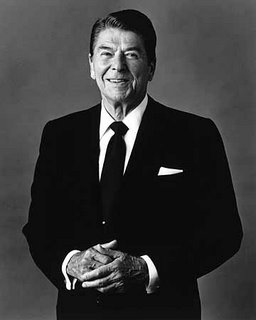 "Last weekend was the 25th anniversary of a turning point in Western civilization: the Reagan tax cut of 1981. Aside from an approving editorial in the Wall Street Journal, however, there was hardly a peep in the mainstream media.
That's not surprising: Ronald Reagan and his tax cuts remain highly suspect in the highly statist world of the national press corps. Among the chattering classes, and even among many tax-cutting enthusiasts, there is still little appreciation of the broader significance of the tax-cutting movement that swept Reagan into office in 1981.
It was far more than a revolt of hard-pressed taxpayers, who, acting out of base self-interest, greedily wished to keep more of their paycheck (or in the left's view, the dividend check). It was far more than a matter of making the economy more "efficient." It was an outward manifestation of a sea change in public attitudes about the proper role of government itself.
Reagan gave voice to that sea change, sometimes coarsely - "the most feared words in the English language are 'the government is here to help you'" - and sometimes eloquently, as when he lectured students at Moscow State University about what my late colleague Warren Brookes called "the economy in mind" - the good things that happen when government power is limited...
...Reagan's optimistic message that freedom and markets can do a better job of delivering the goods than government still has no serious opponent."
Well put...
 "Last weekend was the 25th anniversary of a turning point in Western civilization: the Reagan tax cut of 1981. Aside from an approving editorial in the Wall Street Journal, however, there was hardly a peep in the mainstream media.
That's not surprising: Ronald Reagan and his tax cuts remain highly suspect in the highly statist world of the national press corps. Among the chattering classes, and even among many tax-cutting enthusiasts, there is still little appreciation of the broader significance of the tax-cutting movement that swept Reagan into office in 1981.
It was far more than a revolt of hard-pressed taxpayers, who, acting out of base self-interest, greedily wished to keep more of their paycheck (or in the left's view, the dividend check). It was far more than a matter of making the economy more "efficient." It was an outward manifestation of a sea change in public attitudes about the proper role of government itself.
Reagan gave voice to that sea change, sometimes coarsely - "the most feared words in the English language are 'the government is here to help you'" - and sometimes eloquently, as when he lectured students at Moscow State University about what my late colleague Warren Brookes called "the economy in mind" - the good things that happen when government power is limited...
...Reagan's optimistic message that freedom and markets can do a better job of delivering the goods than government still has no serious opponent."
Well put...
Tonight's Lineup
 On CNBC's "Kudlow & Company" tonight:
Democratic U.S. Senate candidate Ned Lamont will join us in a "Washington to Wall Street" discussion on a wide range of issues including terrorism, the war in Iraq and the outlook for Democrats.
Rep. David Dreier (R-CA) and Rep. Artur Davis (D-AL) will weigh in on the political and economic discussion.
An economic roundtable with Donald Luskin, CIO for Trend Microlytics LLC; Martin Baily, former Chairman of the Council of Economic Advisors/Senior Fellow at the Institute for International Economics; Nariman Behravesh, chief economist for Global Insight; and CNBC anchor/all-star Ron Insana.
Pat Dorsey, Director of Stock Research at Morningstar, will offer his take on the markets.
What We're Up Against
(From the cover story in today's New York Post, BRIT 'BABY BOMB' BEASTS)
"Twisted young British parents planned to sacrifice their precious baby in the evil cause of jihad by mass murder.
Fanatical terror suspect Abdula Ahmed Ali, 25, and his wife, Cossor, 23, are among those being interrogated by police as suspects in the massive plot to attack trans-Atlantic flights in midair.
What the outwardly normal couple had secretly plotted is almost too horrifying to consider, cops said.
The Alis planned to use 6-month-old son Zain's baby bottle as a liquid bomb, blowing themselves and their child up, along with hundreds of others aboard the flight...
...British security experts suspect that Cossor Ali is an example of a chilling phenomenon that is growing in popularity among the terror set - a woman willing to use her innocent appearance to allay suspicions and carry out a suicide bombing. At least 20 Muslim women have blown themselves up in such attacks.
Particularly disturbing was Cossor Ali's apparent intent to conceal the liquid trigger for a bomb in Zain's baby bottle when the family boarded a jetliner.
"It may be beyond belief, but we are convinced that there are now women in Britain who are prepared to die with their babies for their twisted cause," a security adviser to the British government told The Times of London.
"They are ruthless, single-minded and totally committed."
"Twisted young British parents planned to sacrifice their precious baby in the evil cause of jihad by mass murder.
Fanatical terror suspect Abdula Ahmed Ali, 25, and his wife, Cossor, 23, are among those being interrogated by police as suspects in the massive plot to attack trans-Atlantic flights in midair.
What the outwardly normal couple had secretly plotted is almost too horrifying to consider, cops said.
The Alis planned to use 6-month-old son Zain's baby bottle as a liquid bomb, blowing themselves and their child up, along with hundreds of others aboard the flight...
...British security experts suspect that Cossor Ali is an example of a chilling phenomenon that is growing in popularity among the terror set - a woman willing to use her innocent appearance to allay suspicions and carry out a suicide bombing. At least 20 Muslim women have blown themselves up in such attacks.
Particularly disturbing was Cossor Ali's apparent intent to conceal the liquid trigger for a bomb in Zain's baby bottle when the family boarded a jetliner.
"It may be beyond belief, but we are convinced that there are now women in Britain who are prepared to die with their babies for their twisted cause," a security adviser to the British government told The Times of London.
"They are ruthless, single-minded and totally committed."
Tuesday, August 15, 2006
Give Them the Boot
 “…Richard Perle, former Defense Department official and currently an adviser to the Defense Department, wrote a very interesting article. The title is "We Should Not Tolerate the Preachers of Jihad." This is a particular little bugaboo of mine, a burr under my saddle. Imams preaching in mosques and imams preaching in these schools, we see them all over the country. They're preaching destruction of America. They prey on our liberal democracy and the openings we give them and the visas we give their students. Why don't we boot all of these people out?… I say the imams must go right now. They hate this country.”
CNBC’s Kudlow & Company, 8/14
Smiling (crazy-ass) Villain
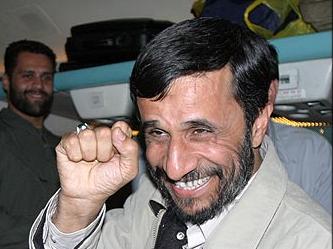
"O villain, villain, smiling, damned villain!
My tables,—meet it is I set it down,
That one may smile, and smile, and be a villain:
At least I ’m sure it may be so in Denmark."
- Shakespeare, Hamlet. Act i. Sc. 5.
Milder Inflation
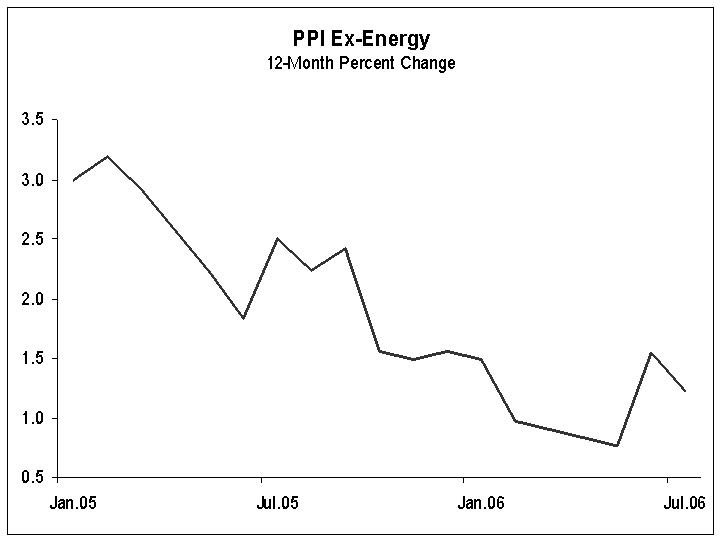 Today’s low PPI report punches a big hole in the inflation story.
 The core PPI is only 1.3 percent over the past year. Probably more important, the PPI ex-energy is 1.2 percent, compared to a 3.2 percent peak in early 2005.
Gold dropped over $6.
We’ll see about the CPI tomorrow. The key number to watch is the chain weighted CPI.
Churchill's Wisdom
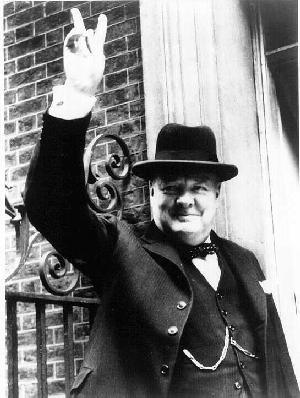 "I am an optimist. It does not seem too much use being anything else."
"Courage is rightly esteemed the first of human qualities... because it is the quality which guarantees all others."
"An appeaser is one who feeds a crocodile, hoping it will eat him last."
"Some regard private enterprise as if it were a predatory tiger to be shot. Others look upon it as a cow that they can milk. Only a handful see it for what it really is - the strong horse that pulls the whole cart."
"Victory at all costs, victory in spite of all terror, victory however long and hard the road may be; for without victory, there is no survival."
"One ought never to turn one's back on a threatened danger and try to run away from it. If you do that, you will double the danger. But if you meet it promptly and without flinching, you will reduce the danger by half. Never run away from anything. Never!"
Monday, August 14, 2006
Give Them the Tools They Need
“Britain's successful preemption of an Islamicist plot to destroy up to 10 civilian airliners over the Atlantic Ocean proves that surveillance, and other forms of information-gathering, remain an essential weapon in prosecuting the war on terror. There was never any real doubt of this, of course. Al Qaeda's preferred targets are civilians, and civilians have a right to be protected from such deliberate and calculated attacks. Denying the terrorists funding, striking at their bases and training camps, holding accountable governments that promote terror and harbor terrorists, and building democracy around the world are all necessary measures in winning the war. None of these, however, can substitute for anticipating and thwarting terror operations as the British have done. This requires the development and exploitation of intelligence.
Despite this self-evident truth, critics of President Bush and the war on terror have relentlessly opposed virtually every effort to expand and improve the government's ability to gather the type of information needed to detect and prevent terrorist attacks, whether in the form of the Patriot Act's "national security" letters and delayed notification warrants (derisively described by pseudo-civil libertarians as "sneak and peak" warrants), the NSA's once secret program to intercept al Qaeda communications into and out of the U.S., and the Treasury Department's efforts to monitor financial transactions through the "SWIFT" system. These, and similar measures, are among the tools that we will need to finish the job...” – Today’s Wall Street Journal, “The British Way”
David Rivkin and Lee Casey's op-ed delivers a spot-on analysis of how the Brits are afforded greater flexibility in their fight on terrorism, and how we need greater latitude here at home in order to ferret out terrorists.
This is what Michael Chertoff has been calling for, and he’s exactly right. The Department of Homeland Security chief told Fox News yesterday that we need the ability to be as nimble as possible with surveillance. That’s what gives the Brits an advantage over the U.S. right now, along with their ability to hold suspects for a longer period of time.
We need to use all the tools we possibly can in catching terrorists. The big question right now is whether we’re using all the tools available to us, or whether the liberal-ACLU-left is compromising our fight against these evildoers.
Another thought here is that Bush should get out there and make this “the” election year issue. There’s really no greater issue. All the politicians ought to be put on record where they stand. Bush needs to make a strong push here.
By the way, it’s not enough for the GOP to label Dems soft on terrorism—Republicans need to get specific, offer concrete proposals, and make Dems reveal their cards. If the Dems want to get tough on this issue (finally), well fine, God bless ‘em.
But if they’re going to fall back and blindly support civil liberties during wartime that is not fine, and they need to be called out for it. They’ll pay dearly for it on November 7th.
Incidentally, Ned Lamont looked like a deer in headlights on Fox News yesterday when he was asked about security. When Chris Wallace asked a befuddled Ned Lamont whether there was any specific measure in the Patriot Act he wanted removed, Lamont hemmed and hawed something about defending librarians. Huh?
Its not the librarians I’m worried about, it’s the terrorists. Someone needs to give Ned Lamont, and the rest of the national security-saboteurs a serious wake-up call.
Get out of the way and give the men and women charged with the enormous responsiblity of protecting American lives all the tools they need.
Despite this self-evident truth, critics of President Bush and the war on terror have relentlessly opposed virtually every effort to expand and improve the government's ability to gather the type of information needed to detect and prevent terrorist attacks, whether in the form of the Patriot Act's "national security" letters and delayed notification warrants (derisively described by pseudo-civil libertarians as "sneak and peak" warrants), the NSA's once secret program to intercept al Qaeda communications into and out of the U.S., and the Treasury Department's efforts to monitor financial transactions through the "SWIFT" system. These, and similar measures, are among the tools that we will need to finish the job...” – Today’s Wall Street Journal, “The British Way”
David Rivkin and Lee Casey's op-ed delivers a spot-on analysis of how the Brits are afforded greater flexibility in their fight on terrorism, and how we need greater latitude here at home in order to ferret out terrorists.
This is what Michael Chertoff has been calling for, and he’s exactly right. The Department of Homeland Security chief told Fox News yesterday that we need the ability to be as nimble as possible with surveillance. That’s what gives the Brits an advantage over the U.S. right now, along with their ability to hold suspects for a longer period of time.
We need to use all the tools we possibly can in catching terrorists. The big question right now is whether we’re using all the tools available to us, or whether the liberal-ACLU-left is compromising our fight against these evildoers.
Another thought here is that Bush should get out there and make this “the” election year issue. There’s really no greater issue. All the politicians ought to be put on record where they stand. Bush needs to make a strong push here.
By the way, it’s not enough for the GOP to label Dems soft on terrorism—Republicans need to get specific, offer concrete proposals, and make Dems reveal their cards. If the Dems want to get tough on this issue (finally), well fine, God bless ‘em.
But if they’re going to fall back and blindly support civil liberties during wartime that is not fine, and they need to be called out for it. They’ll pay dearly for it on November 7th.
Incidentally, Ned Lamont looked like a deer in headlights on Fox News yesterday when he was asked about security. When Chris Wallace asked a befuddled Ned Lamont whether there was any specific measure in the Patriot Act he wanted removed, Lamont hemmed and hawed something about defending librarians. Huh?
Its not the librarians I’m worried about, it’s the terrorists. Someone needs to give Ned Lamont, and the rest of the national security-saboteurs a serious wake-up call.
Get out of the way and give the men and women charged with the enormous responsiblity of protecting American lives all the tools they need.
Alive and Kicking
(The U.S. economy is still hitting on all cylinders. Rising jobs and incomes appear to be trumping higher gas prices and cooling within the housing sector. Lots of economic data out this week on inflation, production, and housing—will tell us whether Q3 could be growing at 3 percent to 3.5 percent, rather than 1 to 2 percent, as the cult of the bear would have it. Here's a portion of my latest column ("Alive and Kicking") at National Review Online that discusses all this in greater detail...)
"The great American consumer has been written off so many times in the last couple of years, just like the rest of the economy. But he/she is alive and kicking. Another great story never told.
Retail sales came in at 1.4 percent for July, way above Wall Street expectations, while core sales excluding autos, gas, and building materials — a number that feeds directly into GDP — increased 0.6 percent. Over the past 3 months core sales rose 6.7 percent at annual rate, and in the past year they’re up 7.4 percent. Excluding autos alone, sales have gained 9.2 percent in the last 12 months. That’s big time.
Sales of consumer durables also were strong. Some economists sounded the death knell for consumers when durable sales dropped in the second quarter. But in the newly released July report, durable-goods sales rose across the board: 3.1 percent for cars, 1.9 percent for electronics and appliances, 1.8 percent for building materials, and 0.5 percent for furniture. These are fat monthly gains.
Far too many investors, hedge fund managers, and economists link the housing slowdown to an imminent consumer collapse. These bears are also quick to add rising gas prices and higher interest rates into their pessimistic outlooks. But they skip two very significant data points: jobs and incomes are still climbing.
It may well be that Wall Street keeps overestimating the monthly job gains, but the fact remains that jobs are being added at a noteworthy clip of about 125,000 per month and the unemployment rate remains low. Because hours worked and wages continue to rise, incomes are still increasing at a comfortable 6 to 6.5 percent yearly pace. If jobs and wages were falling each month, you could write off consumer spending. But that’s simply not happening.
Charles Biderman, of Trim Tabs Investment Research in Santa Rosa, California, adds an additional bullish factoid: Individuals now hold $6.3 trillion in savings accounts, money market funds, and CDs. In contrast, short-term debt — notably credit card and installment debt — stands at only $2.2 trillion, and is growing slowly. So, despite the housing slump, consumers have an excellent cash position. That is why Biderman is very bullish on the stock market, which he thinks will rise by 15 to 20 percent by year-end.
The cult of the bear will also be wrong on business capex spending. American businesses have even more cash on hand than consumers, bolstered by second-quarter profits that came in 4 or 5 percentage points above estimates. Even though business equipment and software investment declined 1 percent at an annual rate in the second quarter, it rose 15.6 percent in the first quarter. Averaging the two gets you 7.3 percent business capex for the first half of the year, and 6.9 percent for the last four quarters. Pretty hefty.
Since low tax rates on capital have rejuvenated investment returns and the overall economy’s animal spirits, this trend will only continue. Today’s low tax environment is also a job creator, as is the red-hot corporate and commercial real-estate market...."
"The great American consumer has been written off so many times in the last couple of years, just like the rest of the economy. But he/she is alive and kicking. Another great story never told.
Retail sales came in at 1.4 percent for July, way above Wall Street expectations, while core sales excluding autos, gas, and building materials — a number that feeds directly into GDP — increased 0.6 percent. Over the past 3 months core sales rose 6.7 percent at annual rate, and in the past year they’re up 7.4 percent. Excluding autos alone, sales have gained 9.2 percent in the last 12 months. That’s big time.
Sales of consumer durables also were strong. Some economists sounded the death knell for consumers when durable sales dropped in the second quarter. But in the newly released July report, durable-goods sales rose across the board: 3.1 percent for cars, 1.9 percent for electronics and appliances, 1.8 percent for building materials, and 0.5 percent for furniture. These are fat monthly gains.
Far too many investors, hedge fund managers, and economists link the housing slowdown to an imminent consumer collapse. These bears are also quick to add rising gas prices and higher interest rates into their pessimistic outlooks. But they skip two very significant data points: jobs and incomes are still climbing.
It may well be that Wall Street keeps overestimating the monthly job gains, but the fact remains that jobs are being added at a noteworthy clip of about 125,000 per month and the unemployment rate remains low. Because hours worked and wages continue to rise, incomes are still increasing at a comfortable 6 to 6.5 percent yearly pace. If jobs and wages were falling each month, you could write off consumer spending. But that’s simply not happening.
Charles Biderman, of Trim Tabs Investment Research in Santa Rosa, California, adds an additional bullish factoid: Individuals now hold $6.3 trillion in savings accounts, money market funds, and CDs. In contrast, short-term debt — notably credit card and installment debt — stands at only $2.2 trillion, and is growing slowly. So, despite the housing slump, consumers have an excellent cash position. That is why Biderman is very bullish on the stock market, which he thinks will rise by 15 to 20 percent by year-end.
The cult of the bear will also be wrong on business capex spending. American businesses have even more cash on hand than consumers, bolstered by second-quarter profits that came in 4 or 5 percentage points above estimates. Even though business equipment and software investment declined 1 percent at an annual rate in the second quarter, it rose 15.6 percent in the first quarter. Averaging the two gets you 7.3 percent business capex for the first half of the year, and 6.9 percent for the last four quarters. Pretty hefty.
Since low tax rates on capital have rejuvenated investment returns and the overall economy’s animal spirits, this trend will only continue. Today’s low tax environment is also a job creator, as is the red-hot corporate and commercial real-estate market...."
Friday, August 11, 2006
The Supply-Side Revolution
"Common sense told us that when you put a big tax on something, the people will produce less of it. So we cut the people's tax rates, and the people produced more than ever before." -President Reagan’s Farewell Speech
Exactly twenty-five years ago, Ronald Reagan signed into law the first supply-side tax cuts since the JFK plan of the early 1960s. By reducing high marginal tax rates, Reagan transformed the American economy and opened the door to two-and-half decades of prosperity. Economic behavior responds significantly to the incentive power of low tax rates that raise the after-tax return on work, investment, and risk-taking.
Over this time span, the U.S. has experienced only six quarters of negative GDP -- a remarkable performance. Roughly 45 million new jobs have been created, with the economy averaging about 3.5 percent real growth each year. In the 1980s, as the economy supplied more goods to absorb the Fed’s money supply, inflation plunged from the stagflationary 1970s. Meanwhile, entire new technology industries sprung up, forming an information economy that has transformed business and productivity.
Stock markets exploded in the Schumpeterian environment of entrepreneurship that Reagan helped launch. Wealth creation reached unheard of levels among the 100 million investors who were spurred by new incentives to keep more of what they earned, saved, and invested. Capitalism was rejuvenated in the U.S., and then it spread around the world.
Ankle-biting, demand-side Keynesians (most of whom reside in the Democratic party) are always looking for blotches, hanging toenails, and the occasional scrape on what is today’s muscular and statuesque American economic body. But the genial and optimistic Mr. Reagan undoubtedly chuckles from his perch on high, as he watches his critics scramble to come up with a coherent opposing idea. They can’t, and they won’t.
One of Reagan’s big ideas was that tax incentives matter. It has been a blockbuster, runaway success. But even today, twenty-five years later, it remains the greatest economic story never told.
Exactly twenty-five years ago, Ronald Reagan signed into law the first supply-side tax cuts since the JFK plan of the early 1960s. By reducing high marginal tax rates, Reagan transformed the American economy and opened the door to two-and-half decades of prosperity. Economic behavior responds significantly to the incentive power of low tax rates that raise the after-tax return on work, investment, and risk-taking.
Over this time span, the U.S. has experienced only six quarters of negative GDP -- a remarkable performance. Roughly 45 million new jobs have been created, with the economy averaging about 3.5 percent real growth each year. In the 1980s, as the economy supplied more goods to absorb the Fed’s money supply, inflation plunged from the stagflationary 1970s. Meanwhile, entire new technology industries sprung up, forming an information economy that has transformed business and productivity.
Stock markets exploded in the Schumpeterian environment of entrepreneurship that Reagan helped launch. Wealth creation reached unheard of levels among the 100 million investors who were spurred by new incentives to keep more of what they earned, saved, and invested. Capitalism was rejuvenated in the U.S., and then it spread around the world.
Ankle-biting, demand-side Keynesians (most of whom reside in the Democratic party) are always looking for blotches, hanging toenails, and the occasional scrape on what is today’s muscular and statuesque American economic body. But the genial and optimistic Mr. Reagan undoubtedly chuckles from his perch on high, as he watches his critics scramble to come up with a coherent opposing idea. They can’t, and they won’t.
One of Reagan’s big ideas was that tax incentives matter. It has been a blockbuster, runaway success. But even today, twenty-five years later, it remains the greatest economic story never told.
Tonight's Lineup
 On CNBC's "Kudlow & Company" tonight:
We'll begin with a look at airline security. Michael Boyd, founder of the Boyd Group (airport analysis and consulting firm) and Steve Pomerantz, Former Deputy Director and Director of Counterterrorism, FBI will weigh in.
Terrorism & Politics: Do Dems have a problem here? Conservative commentator Ann Coulter will duke it out with David Sirota, author and political strategist.
A look into the stock market with bullish Charles Biderman, Founder/CEO of TrimTabs Investment Research and Herb Greenberg, senior Marketwatch columnist.
Bear Stearns retail analyst Dana Telsey will address today's strong retail numbers.
And finally, a supply-side tax debate between the legendary Art Laffer and Jason Furman, senior fellow at the Center on Budget and Policy Priorities.
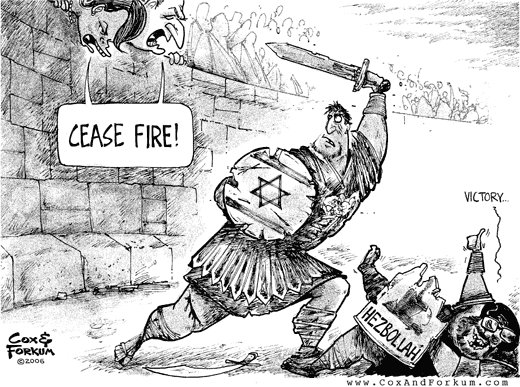
Thursday, August 10, 2006
God Bless the Brits
 “We are confident that we have disrupted a plan by terrorists to cause untold death and destruction and to commit, quite frankly, mass murder. Put simply, this was intended to be mass murder on an unimaginable scale.”-London Metropolitan Police commissioner Paul Stephenson
Just in case anybody forgot, we are in the middle of a war.
Thank God for the British authorities. They did excellent work in unearthing this latest evil plot.
By the way, they used “sneak and peak” tactics to go into the homes of the terrorist suspects. These are tactics not permitted in the U.S. without a warrant.
There’s a lesson here: Give the authorities whatever powers they need during wartime. Let’s not forget the importance of total electronic surveillance, in addition to “sneak and peek.”
By the time you tell the right number of Senators, House members, various judges, assorted bureaucrats and God knows who else, it could be too late. Please think of that.
There are reasons for taking these wartime measures which may infringe upon civil liberties, but does anyone truly believe we should be worried about the civil liberties of terrorists?
It is a miracle that the British security folks uncovered this plot. Their work saved untold innocent lives. God bless them.
Tonight's Lineup
 On CNBC's "Kudlow & Company" tonight:
We'll begin the show with an update of the latest news surrounding the foiled terrorist bombing plot of commerical airlines, then hear from our roundtable of terrorism experts.
Our guests include Neil Livingstone, CEO of GlobalOptions, an international risk management company; Bill Daly, former FBI Investigator/Sr. V.P. of Control Risk Group; and Scott Weber, Senior Counselor at the U.S. Department of Homeland Security.
Rep. Chris Shays (R-CT) will join us to discuss homeland security.
Gordon Bethune, former CEO/Chairman of Continental Airlines, will address the impact on the airline industry.
Our market panel will look into terrorism's impact on the markets and economy.
Our guests include John Augustine, Chief Investment Strategist for Fifth Third Asset Management; Stefan Abrams, CIO at Trust Company of the West; John Silvia, chief economist at Wachovia.
Our Evil Enemy
"I'm worried that too many people, both in politics and out, don't appreciate the seriousness of the threat to American security and the evil of the enemy that faces us - more evil or as evil as Nazism and probably more dangerous than the Soviet Communists we fought during the long Cold War. If we just pick up like Ned Lamont wants us to do, get out by a date certain, it will be taken as a tremendous victory by the same people who wanted to blow up these planes in this plot hatched in England. It will strengthen them and they will strike again." - Sen. Joe Lieberman in remarks announcing his independent bid earlier today.
"Bloodthirsty Barbarians"
(Here's a noteworthy comment posted here on Money Politic$ by one of our regulars - well worth a read.)
"...The diligent guardians of freedom in Scotland Yard, the London Metropolitan Police and MI5 have proven that comprehensive surveillance, applied with discipline, can save society hundreds of tragic deaths and deny the bloodthirsty barbarians the misplaced joy they so desperately seek.
There was one thing the Honorable Mr. Hume got wrong in his address to the world early this morning. For internal political reasons, I suppose, he stated that this was not a war of one society against another - a clash of civilizations. Merely the rounding up of a few ne'er-do-wells.
With all due respect, the world does not go on high alert if the Brits pick up two dozen pickpockets in Shepherd's Bush or Charing Cross Station. If you listen to the spokespeople for the jihad, it is exactly a clash of civilizations. Nothing else explains the chanting in the streets across the mideast, and the celebration of the shelling of Israel, the "Death to America" signs, and all the rest.
The sooner we draw a sober breath and recognize it as such, the sooner we can begin to build a world worthy of our forebears and safe for our children."
-roadtoserfdom
"...The diligent guardians of freedom in Scotland Yard, the London Metropolitan Police and MI5 have proven that comprehensive surveillance, applied with discipline, can save society hundreds of tragic deaths and deny the bloodthirsty barbarians the misplaced joy they so desperately seek.
There was one thing the Honorable Mr. Hume got wrong in his address to the world early this morning. For internal political reasons, I suppose, he stated that this was not a war of one society against another - a clash of civilizations. Merely the rounding up of a few ne'er-do-wells.
With all due respect, the world does not go on high alert if the Brits pick up two dozen pickpockets in Shepherd's Bush or Charing Cross Station. If you listen to the spokespeople for the jihad, it is exactly a clash of civilizations. Nothing else explains the chanting in the streets across the mideast, and the celebration of the shelling of Israel, the "Death to America" signs, and all the rest.
The sooner we draw a sober breath and recognize it as such, the sooner we can begin to build a world worthy of our forebears and safe for our children."
-roadtoserfdom
Bush's Speech Today
Mr. President, speaking as a strong supporter, couldn’t you have provided us with just a bit more inspiration and leadership in light of today's events?
NYC Mayor Mike Bloomberg talked about courage. He said the secret to winning the terror war is courage. He is absolutely right.
Your inspirational remarks at Ground Zero after 9/11 will never be forgotten. Your words helped to focus and rally a wounded nation.
We know nothing happened today and America and its freedom are intact. With God’s help this will continue.
My suspicion is that you are leaving this to Tony Blair. This is, after all, Mr. Blair’s great moment, and you have been talking with him all night, but just a wee bit more inspiration might work.
NYC Mayor Mike Bloomberg talked about courage. He said the secret to winning the terror war is courage. He is absolutely right.
Your inspirational remarks at Ground Zero after 9/11 will never be forgotten. Your words helped to focus and rally a wounded nation.
We know nothing happened today and America and its freedom are intact. With God’s help this will continue.
My suspicion is that you are leaving this to Tony Blair. This is, after all, Mr. Blair’s great moment, and you have been talking with him all night, but just a wee bit more inspiration might work.
"We need more tools, not less"
“This is yet another reminder, if anyone needed one, that the war on terror is not over. And it is a reminder that our military, law enforcement and intelligence forces are working around the clock and around the world to prevent attacks here at home.
That's why we need more tools, not less, to fight terrorists. It is clear to anyone paying attention that our law enforcement and intelligence forces need every legal means at their disposal to be able connect the dots and prevent and disrupt al Qaeda’s attacks. Tools such as the terrorist surveillance program and others allow us to prevent the attacks before they happen, not just to respond when it’s too late. We must continue to arm our forces, so that they can disarm terrorists.”
-U.S. Senate Majority Whip Mitch McConnell (R-KY)
That's why we need more tools, not less, to fight terrorists. It is clear to anyone paying attention that our law enforcement and intelligence forces need every legal means at their disposal to be able connect the dots and prevent and disrupt al Qaeda’s attacks. Tools such as the terrorist surveillance program and others allow us to prevent the attacks before they happen, not just to respond when it’s too late. We must continue to arm our forces, so that they can disarm terrorists.”
-U.S. Senate Majority Whip Mitch McConnell (R-KY)
Wednesday, August 09, 2006
Tonight's Lineup
 On CNBC's "Kudlow & Company" tonight:
We'll begin with a look at BP's Alaskan pipeline shutdown and its effect on oil and markets. Thomas Rooney, whose company Insituform Technologies, fixes pipelines, will join us, along with energy analyst Charles Swanson from Ernst & Young, which just released a comprehensive oil industry study.
Our core market panel will weigh in on oil and other market-related issues.
Our market guests include: Dennis Kneale, Managing Editor of Forbes Magazine; Bob Froehlich, ViceChairman of Scudder Investments; Michael Pento, Senior Market Strategist at Delta Global Advisors.
Eric Ross, Chief Investment Strategist at Think Equity Partners, will discuss Sprint's WiMax plans as well as the FCC airwaves auction.
CNBC ace Charlie Gasparino will offer some perspective on the unfolding options probe.
Michael Mandel, chief economist for BusinessWeek, will address the mystery of low wage growth.
And, finally, Lanny Davis, former special counsel to President Clinton/author of "Scandal: How 'Gotcha' Politics Is Destroying America" will discuss what's ahead for Joe Lieberman and the Democrats with Human Events editor Terry Jeffrey.
My Thoughts on Lieberman
With all due respect to Sen. Joe Lieberman’s Iraq war support and commitment to the Bush mission of spreading freedom and democracy to the Middle East (a mission I fully support), I’m still not convinced that backing Lieberman with a lot of heavy GOP big money support is a game that is truly worth the candle.
My sense is that Lieberman will tilt away from President Bush in the next three months and start criticizing Bush’s war management. While there is certainly some validity to this (see my NRO column, "Where's Harry Truman?") I think Lieberman will play hardball with Bush and wind up backing some sort of Democratic party troop withdrawal scenario.
The blue state, anti-war Connecticut message was very clear. And Lieberman won’t beat Limosuine-Liberal Ned Lamont unless he caters to that message. He will criticize Bush wherever possible, as by the way, Sen. Hillary Clinton has done. She too, will heed the Lamont election message and shift her position in response to the Connecticut primary.
In other words, the Lamont election message will push Democrats several yards further to the left. So far to the left in fact, that in the next 90 days, the Dems will once again morph back to the anti-war McGovernite “peace” party as Martin Peretz, editor-in-chief of The New Republic recently wrote in the Wall Street Journal. This makes it possible that the new McGovernite Democrats will snatch defeat from the jaws of victory.
For a whole bunch of reasons, including war mismanagement (not the mission, but the poor management of the mission), high gas prices, the housing slump, rising interest rates, continued congressional GOP overspending, and their failure to get a broad based immigration reform bill passed, I think if the election were held today, the Dems would pick up 15-30 seats in the House, and 5-6 seats in the Senate.
Indeed, moderate to conservative Democrat Harold Ford of Tennessee could surprise everyone with a victory that would tip the Senate into Republican hands. Ford has supported investor tax cuts, eliminating the death tax, a 1 percent across the board budget cut, and PayGo to reduce the budget deficit.
In stark contrast to Joe Lieberman, who votes the Democratic party line on high tax and high spend issues, Congressman Ford has been exemplary in promoting pro-growth policies to reduce taxing and spending.
Ford could be the pivotal Senate election tipping point. He supports the Iraq mission, while criticizing the war management, and simultaneously votes as a supply-sider on the economy.
Lieberman will do no such thing. And should Lieberman win as an Independent in Connecticut, he will caucus with the Dems and continue his roughly 90% pro-Democrat voting record.
This is why GOP big money guys have other fish to fry in a number of other key Senate races where the election of Republicans could maintain a GOP senate. However, the election of Lieberman will push to a Democratic Senate.
The contrast between Harold Ford and Joe Lieberman is very interesting. Ford is very much a JFK type democrat (pro-business, pro-growth, and pro-tax cuts)—whereas Lieberman is a Hubert Humphrey Democrat (a big government tax and spender).
Personally, I would take Ford over Lieberman. Particularly because I think the Lamont election in Connecticut will push Lieberman further to the left.
My sense is that Lieberman will tilt away from President Bush in the next three months and start criticizing Bush’s war management. While there is certainly some validity to this (see my NRO column, "Where's Harry Truman?") I think Lieberman will play hardball with Bush and wind up backing some sort of Democratic party troop withdrawal scenario.
The blue state, anti-war Connecticut message was very clear. And Lieberman won’t beat Limosuine-Liberal Ned Lamont unless he caters to that message. He will criticize Bush wherever possible, as by the way, Sen. Hillary Clinton has done. She too, will heed the Lamont election message and shift her position in response to the Connecticut primary.
In other words, the Lamont election message will push Democrats several yards further to the left. So far to the left in fact, that in the next 90 days, the Dems will once again morph back to the anti-war McGovernite “peace” party as Martin Peretz, editor-in-chief of The New Republic recently wrote in the Wall Street Journal. This makes it possible that the new McGovernite Democrats will snatch defeat from the jaws of victory.
For a whole bunch of reasons, including war mismanagement (not the mission, but the poor management of the mission), high gas prices, the housing slump, rising interest rates, continued congressional GOP overspending, and their failure to get a broad based immigration reform bill passed, I think if the election were held today, the Dems would pick up 15-30 seats in the House, and 5-6 seats in the Senate.
Indeed, moderate to conservative Democrat Harold Ford of Tennessee could surprise everyone with a victory that would tip the Senate into Republican hands. Ford has supported investor tax cuts, eliminating the death tax, a 1 percent across the board budget cut, and PayGo to reduce the budget deficit.
In stark contrast to Joe Lieberman, who votes the Democratic party line on high tax and high spend issues, Congressman Ford has been exemplary in promoting pro-growth policies to reduce taxing and spending.
Ford could be the pivotal Senate election tipping point. He supports the Iraq mission, while criticizing the war management, and simultaneously votes as a supply-sider on the economy.
Lieberman will do no such thing. And should Lieberman win as an Independent in Connecticut, he will caucus with the Dems and continue his roughly 90% pro-Democrat voting record.
This is why GOP big money guys have other fish to fry in a number of other key Senate races where the election of Republicans could maintain a GOP senate. However, the election of Lieberman will push to a Democratic Senate.
The contrast between Harold Ford and Joe Lieberman is very interesting. Ford is very much a JFK type democrat (pro-business, pro-growth, and pro-tax cuts)—whereas Lieberman is a Hubert Humphrey Democrat (a big government tax and spender).
Personally, I would take Ford over Lieberman. Particularly because I think the Lamont election in Connecticut will push Lieberman further to the left.
Lieberman Perspectives
John McIntyre, Real Clear Politics
“Democrats lost the 2004 presidential election over leadership on national security. Last night's win by anti-war Ned Lamont over pro-war Joe Lieberman, while joyous for the far-left netroots crowd, is a bad harbinger for future Democratic Party prospects nationally in 2008 and beyond…
…Nationally, the images from last night are a disaster for the Democratic Party. Perched behind Lamont during his victory speech were the Reverends Al Sharpton and Jesse Jackson, grinning ear to ear, serenaded by the chant of "Bring Them Home, Bring Them Home." For a party that has a profound public relations and substantive problem on national security, these are not exactly the images you want broadcast to the nation.
Anti-war Democrats and much of the mainstream media continue to confuse anti-war with anti-lose. The incessant commentary that 2/3rd of the country is against the war completely misreads the American public, as much of the negativity towards the war isn't because we are fighting, but rather a growing feeling that we are not fighting to win or not fighting smart.
Democrats went down this road in the late 1960's with Vietnam and they are still carrying the baggage from that leftward turn. Lamont's win is a big step back to that losing formula…in the long run the real victim will be the Democratic Party if they continue to purge the few remaining FDR/Truman/Scoop Jackson Democrats from their ranks.”
Dick Morris, New York Post
“Reports of Joe Lieberman's political death are (as Mark Twain once said of rumors of his own demise) "premature and grossly exaggerated." Lieberman has lost a battle, but he can still win the war running as an independent…
…Freed of the confines of the Democratic primary, Lieberman can now appeal to independents, Republicans and mainstream Democrats who were not sufficiently motivated to participate in the primary, he can win.
…Lieberman's primary defeat sends a message to all presidential contenders, particularly Sen. Hillary Clinton, that they have to move to the left on the war or be buried by the party's increasingly radical and leftist base….”
Hartford Courant
Make no mistake, The Courant's editorial board endorsed Mr. Lieberman in the primary because he built a fine record over his 18 years in the Senate. His experience and his ability to work with colleagues across the aisle are of value to his state and the nation. He has a more realistic notion than does Mr. Lamont about the timing and conditions for the United States to leave Iraq.
A majority of Democrats who voted Tuesday, however, had no patience with Mr. Lieberman's bipartisan ways and his support for the war. He may find a friendlier reception in the general election campaign if he makes good on his intention to run an independent candidacy.
The Dallas Morning News
"...Mr. Lieberman lost for one reason: his support for the war in Iraq and President Bush's leadership.
Because of that, liberals will be tempted to draw from the Connecticut result national lessons about the depth of the anti-war vote this election year.
They shouldn't. For one thing, party primaries always bring out the most committed partisans. That a majority of Democratic primary voters in a blue Northeastern state prefer the peace candidate is no bellwether for the rest of the country.
Besides, polls indicate that if Mr. Lieberman makes good on his promise to run this fall as an independent, he'll win the general election. If that happens, the Democrats will lose a seat in the Senate. Advantage: GOP...."
Michael Goodwin, NY Daily News
“…So now that the wackadoo wing of the party has a bloody scalp, what are they going to do with it? Wave it at Islamic terrorists in Iraq and Lebanon and Afghanistan and Indonesia and Great Britain and Spain and Israel and New York and declare peace? That will work for sure. They better also wear armor and duck.
Lieberman is the first casualty of the war against the war on terror. If last night's results are a window on the party's tilt, then a huge slice of the Democratic party is ready to sit out the war to protect America. God help us if the Republicans also get the wobblies. Let's hope the Connecticut Condition isn't contagious. And let's hope last night's decision is overturned…
…I believe that Islamic terrorists will stop at nothing in their mad quest to rule the globe. As a result, World War III has started, whether we like it or not. It will continue, whether we fight back or not. But if we think we can win by not fighting, then we're not just wrong. We're nuts. As in nutmeg.”
“Democrats lost the 2004 presidential election over leadership on national security. Last night's win by anti-war Ned Lamont over pro-war Joe Lieberman, while joyous for the far-left netroots crowd, is a bad harbinger for future Democratic Party prospects nationally in 2008 and beyond…
…Nationally, the images from last night are a disaster for the Democratic Party. Perched behind Lamont during his victory speech were the Reverends Al Sharpton and Jesse Jackson, grinning ear to ear, serenaded by the chant of "Bring Them Home, Bring Them Home." For a party that has a profound public relations and substantive problem on national security, these are not exactly the images you want broadcast to the nation.
Anti-war Democrats and much of the mainstream media continue to confuse anti-war with anti-lose. The incessant commentary that 2/3rd of the country is against the war completely misreads the American public, as much of the negativity towards the war isn't because we are fighting, but rather a growing feeling that we are not fighting to win or not fighting smart.
Democrats went down this road in the late 1960's with Vietnam and they are still carrying the baggage from that leftward turn. Lamont's win is a big step back to that losing formula…in the long run the real victim will be the Democratic Party if they continue to purge the few remaining FDR/Truman/Scoop Jackson Democrats from their ranks.”
Dick Morris, New York Post
“Reports of Joe Lieberman's political death are (as Mark Twain once said of rumors of his own demise) "premature and grossly exaggerated." Lieberman has lost a battle, but he can still win the war running as an independent…
…Freed of the confines of the Democratic primary, Lieberman can now appeal to independents, Republicans and mainstream Democrats who were not sufficiently motivated to participate in the primary, he can win.
…Lieberman's primary defeat sends a message to all presidential contenders, particularly Sen. Hillary Clinton, that they have to move to the left on the war or be buried by the party's increasingly radical and leftist base….”
Hartford Courant
Make no mistake, The Courant's editorial board endorsed Mr. Lieberman in the primary because he built a fine record over his 18 years in the Senate. His experience and his ability to work with colleagues across the aisle are of value to his state and the nation. He has a more realistic notion than does Mr. Lamont about the timing and conditions for the United States to leave Iraq.
A majority of Democrats who voted Tuesday, however, had no patience with Mr. Lieberman's bipartisan ways and his support for the war. He may find a friendlier reception in the general election campaign if he makes good on his intention to run an independent candidacy.
The Dallas Morning News
"...Mr. Lieberman lost for one reason: his support for the war in Iraq and President Bush's leadership.
Because of that, liberals will be tempted to draw from the Connecticut result national lessons about the depth of the anti-war vote this election year.
They shouldn't. For one thing, party primaries always bring out the most committed partisans. That a majority of Democratic primary voters in a blue Northeastern state prefer the peace candidate is no bellwether for the rest of the country.
Besides, polls indicate that if Mr. Lieberman makes good on his promise to run this fall as an independent, he'll win the general election. If that happens, the Democrats will lose a seat in the Senate. Advantage: GOP...."
Michael Goodwin, NY Daily News
“…So now that the wackadoo wing of the party has a bloody scalp, what are they going to do with it? Wave it at Islamic terrorists in Iraq and Lebanon and Afghanistan and Indonesia and Great Britain and Spain and Israel and New York and declare peace? That will work for sure. They better also wear armor and duck.
Lieberman is the first casualty of the war against the war on terror. If last night's results are a window on the party's tilt, then a huge slice of the Democratic party is ready to sit out the war to protect America. God help us if the Republicans also get the wobblies. Let's hope the Connecticut Condition isn't contagious. And let's hope last night's decision is overturned…
…I believe that Islamic terrorists will stop at nothing in their mad quest to rule the globe. As a result, World War III has started, whether we like it or not. It will continue, whether we fight back or not. But if we think we can win by not fighting, then we're not just wrong. We're nuts. As in nutmeg.”
Tuesday, August 08, 2006
They Still Ring True
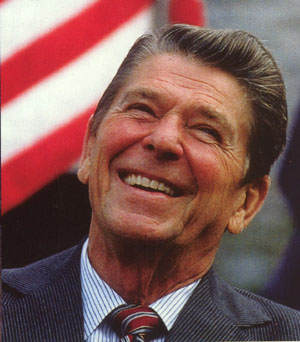 "When action is required to preserve our national security, we will act. We will maintain sufficient strength to prevail if need be, knowing that if we do so we have the best chance of never having to use that strength. Above all, we must realize that no arsenal or no weapon in the arsenals of the world is so formidable as the will and moral courage of free men and women. It is a weapon our adversaries in today's world do not have. It is a weapon that we as Americans do have. Let that be understood by those who practice terrorism and prey upon their neighbors. I'm told that tens of thousands of prayer meetings are being held on this day, and for that I'm deeply grateful. We are a nation under God, and I believe God intended for us to be free."
-President Reagan, January 20, 1981, First Inaugural Address
Tonight's Lineup
 On CNBC's "Kudlow & Company" tonight:
We'll begin with a thorough discussion of today's Fed decision with Diane Swonk, chief economist at Mesirow Financial; Donald Luskin, Chief Investment Officer for Trend Macrolytics; Robert Reich, former Clinton Labor Secretary; and Nouriel Roubini, professor of economics at NYU's Stern School.
An oil/energy debate with Montana Gov. Brian Schweitzer (D), Alaska Gov. Frank Murkowsi (R) and Dan Yergin, chairman/co-founder of Cambridge Energy Research Associates.
A look at market reaction to the Fed and oil concerns with Jeff Macke, founder and president of Macke Asset Management and John Augustine, Chief Investment Strategist for Fifth Third Asset Management.
And a discussion about Sen. Joe Lieberman's (D-CT) primary battle with Hartford Courant columnist Kevin Rennie.
The Real Deal on Oil
The Washington Times has a very good article today (“Big Oil reinvests big profits to tap costlier reserves”) illustrating how oil companies are using their big profits to reinvest heavily in oil exploration and development.
It is a very important story in light of BP’s shutdown of its pipeline in Prudhoe Bay, Alaska. This story has unleashed the tired chorus of big oil bashing attacks that greedy oil firms are making profits, but not reinvesting to expand production. Liberals like to believe that confiscating Lee Raymond’s bank account and charging Big Oil a windfall profits tax will somehow solve our energy problem.
Well, guess what? A new independent report from Ernst and Young contradicts all this nonsense.
The study reveals that while oil companies posted big profits of $336 billion between 1995 and 2005, they spent even more on new investment, to the tune of approximately $550 billion for exploration and development.
Furthermore, oil companies continued borrowing heavily and investing during the lean years, when crude plunge to $10 barrel in 1998. And they continue to invest in today’s boom times. All of this investment occurs despite huge regulatory and environmental obstacles.
Meanwhile, Cambridge Energy Research Associates found that the cost of lifting oil has risen dramatically. Since 2002, the average cost of finding, developing, and producing oil worldwide has jumped 35% to $9.13 a barrel. And the cost to produce Canadian oil sands nearly doubled to $25 a barrel now, compared to $14.50 four years ago. Moreover, skilled workers and engineers are increasingly scarce and average wage gains for oil industry employees are now running about 10 percent above last year.
The Wall Street Journal also has a similarly revealing editorial today (“The Prudhoe Principle”) that exposes the absurdity of Sen. John Kerry and other opponents of opening up drilling ANWR who argue that opening up ANWR really wouldn’t make much of a difference in our oil supply.
“Opponents of opening the Arctic National Wildlife Refuge (ANWR) to oil drilling have long argued that the supply wouldn't make a difference to prices. Well, that claim took a spill yesterday with BP's announcement that it is shutting down its operations at Prudhoe Bay due to a damaged pipeline that could take months to patch.
U.S. crude soared $2.25 on the news, taking oil to nearly $77 a barrel, with experts predicting another five- or 10-cent a gallon price increase at the retail gasoline pump -- possibly to a new high. This market reaction came as some surprise to various newspaper scribes and politicians, given that Prudhoe Bay "only" supplies about 400,000 barrels a day, or less than 2% of daily U.S. oil consumption.
These are the same folks who've delighted in informing Americans in recent years that opening up nearby ANWR to drilling would "only" result in an extra one million barrels a day. This argument -- that ANWR isn't worth the effort -- might have some currency if oil were plentiful and gas prices were still "only" $1.50 a gallon. But with the margin between global oil supply and demand so thin, any supply counts. ANWR is exactly the sort of home-grown oil cushion that would help smooth out supply disruptions from the likes of Katrina or the BP leak, if "only" Congress could get a clue….”
The point here is that BP’s action to fix its pipeline removes nearly half of Alaska’s production and 8 percent of U.S. production overall. You would need to have your head buried in the sand to suggest ANWR would not matter—it would matter a lot.
And so would the offshore drilling bill due to reconciled between the House and Senate when they get back after Labor Day. This prospective bill to open up the Outer Continental Shelf should be near the very top of the congressional priority list.
But the usual big oil bashers like Rep. John Dingell (D-MI) and Rep. Ed Markey (D-MA) are still out in force, still ignoring the facts, and still standing in the way of opening up new sources of energy. These guys are still “blaming” firms like BP for making record profits. Huh?
It is a very important story in light of BP’s shutdown of its pipeline in Prudhoe Bay, Alaska. This story has unleashed the tired chorus of big oil bashing attacks that greedy oil firms are making profits, but not reinvesting to expand production. Liberals like to believe that confiscating Lee Raymond’s bank account and charging Big Oil a windfall profits tax will somehow solve our energy problem.
Well, guess what? A new independent report from Ernst and Young contradicts all this nonsense.
The study reveals that while oil companies posted big profits of $336 billion between 1995 and 2005, they spent even more on new investment, to the tune of approximately $550 billion for exploration and development.
Furthermore, oil companies continued borrowing heavily and investing during the lean years, when crude plunge to $10 barrel in 1998. And they continue to invest in today’s boom times. All of this investment occurs despite huge regulatory and environmental obstacles.
Meanwhile, Cambridge Energy Research Associates found that the cost of lifting oil has risen dramatically. Since 2002, the average cost of finding, developing, and producing oil worldwide has jumped 35% to $9.13 a barrel. And the cost to produce Canadian oil sands nearly doubled to $25 a barrel now, compared to $14.50 four years ago. Moreover, skilled workers and engineers are increasingly scarce and average wage gains for oil industry employees are now running about 10 percent above last year.
The Wall Street Journal also has a similarly revealing editorial today (“The Prudhoe Principle”) that exposes the absurdity of Sen. John Kerry and other opponents of opening up drilling ANWR who argue that opening up ANWR really wouldn’t make much of a difference in our oil supply.
“Opponents of opening the Arctic National Wildlife Refuge (ANWR) to oil drilling have long argued that the supply wouldn't make a difference to prices. Well, that claim took a spill yesterday with BP's announcement that it is shutting down its operations at Prudhoe Bay due to a damaged pipeline that could take months to patch.
U.S. crude soared $2.25 on the news, taking oil to nearly $77 a barrel, with experts predicting another five- or 10-cent a gallon price increase at the retail gasoline pump -- possibly to a new high. This market reaction came as some surprise to various newspaper scribes and politicians, given that Prudhoe Bay "only" supplies about 400,000 barrels a day, or less than 2% of daily U.S. oil consumption.
These are the same folks who've delighted in informing Americans in recent years that opening up nearby ANWR to drilling would "only" result in an extra one million barrels a day. This argument -- that ANWR isn't worth the effort -- might have some currency if oil were plentiful and gas prices were still "only" $1.50 a gallon. But with the margin between global oil supply and demand so thin, any supply counts. ANWR is exactly the sort of home-grown oil cushion that would help smooth out supply disruptions from the likes of Katrina or the BP leak, if "only" Congress could get a clue….”
The point here is that BP’s action to fix its pipeline removes nearly half of Alaska’s production and 8 percent of U.S. production overall. You would need to have your head buried in the sand to suggest ANWR would not matter—it would matter a lot.
And so would the offshore drilling bill due to reconciled between the House and Senate when they get back after Labor Day. This prospective bill to open up the Outer Continental Shelf should be near the very top of the congressional priority list.
But the usual big oil bashers like Rep. John Dingell (D-MI) and Rep. Ed Markey (D-MA) are still out in force, still ignoring the facts, and still standing in the way of opening up new sources of energy. These guys are still “blaming” firms like BP for making record profits. Huh?
Thoughts Ahead of Fed Decision
Well, today is Fed day, and virtually everyone expects a pause at 5.25 percent. From a supply-side point of view, however, the issue is not as clear-cut. It really boils down to who do you trust: bonds or gold?
The bond market is telling the Fed to pause with long rates dropping below short rates. On an inflation-indexed basis, the yield curve is also inverted. This suggests tight money and a recessionary economic threat.
Gold is sending an entirely different message. While down from its May peak of around $750, gold is trading a little over $650. A year ago, gold was close to $450. Of course the flip side of gold is the dollar, which is also trading weaker. It's almost impossible to reconcile the different messages of bonds and gold.
To some extent, gold is moving with oil, where the September oil contract is just under $77, up from about $58 last December. Perhaps both gold and oil are trading on geopolitical risks, primarily from the Middle East. But if money were truly scarce, you can't help but wonder why both of those commodities are still so high.
Inflation expectations, measured by the TIP spread, are around 260 basis points, about 40 or 50 basis points higher than year ago. Again, if money were really scarce, one would think the breakeven inflation spread would be narrower.
The economy is not nearly as weak as the Keynesian demand-siders would have us believe. Economic growth looks to be moving toward 3 percent, but the split inside nominal GDP has moved toward higher inflation and slower real output. That's the real crux of the Fed's problem. In the second quarter GDP, inflation ran faster than real growth. A touch of stagflation, if you will.
My preference would be a 5.5 percent fed funds rate, then a pause after that.
The bond market is telling the Fed to pause with long rates dropping below short rates. On an inflation-indexed basis, the yield curve is also inverted. This suggests tight money and a recessionary economic threat.
Gold is sending an entirely different message. While down from its May peak of around $750, gold is trading a little over $650. A year ago, gold was close to $450. Of course the flip side of gold is the dollar, which is also trading weaker. It's almost impossible to reconcile the different messages of bonds and gold.
To some extent, gold is moving with oil, where the September oil contract is just under $77, up from about $58 last December. Perhaps both gold and oil are trading on geopolitical risks, primarily from the Middle East. But if money were truly scarce, you can't help but wonder why both of those commodities are still so high.
Inflation expectations, measured by the TIP spread, are around 260 basis points, about 40 or 50 basis points higher than year ago. Again, if money were really scarce, one would think the breakeven inflation spread would be narrower.
The economy is not nearly as weak as the Keynesian demand-siders would have us believe. Economic growth looks to be moving toward 3 percent, but the split inside nominal GDP has moved toward higher inflation and slower real output. That's the real crux of the Fed's problem. In the second quarter GDP, inflation ran faster than real growth. A touch of stagflation, if you will.
My preference would be a 5.5 percent fed funds rate, then a pause after that.
Monday, August 07, 2006
Bears on the Prowl
Judging by recessionary worries in the press and blogosphere, the cult of the bear appears to be alive and well.
The bears are focusing on housing, consumers and the slightly inverted yield curve. It's a heavy demand-side forecast approach. Supply-siders like myself look at low tax-rates on capital, high productivity, record profits, and strong industrial production.
While the jobs trend is slowing, it remains quite healthy. And 100,000 to 120,000 average monthly job gains are consistent with roughly 6 percent growth in personal income. The main point is a very low cost of capital and very high investment returns to nurture investment.
The bears ought to consider the high level of commodity prices as a sign of U.S. and world economic strength. The yield curve is not deeply inverted, but only slightly. Back in 2000 the curve was hugely inverted for about a year and the Fed deflated the money supply in 2000 after rapidly inflating it in 1999.
World political risk and uncertainty is keeping commodity prices way above equilibrium. Inflation-adjusted GDP growth is slowing toward a 3 percent trend line, but this seems more a function of rising inflation, which is crowding out real growth.
Inflation is the biggest factor in the economic outlook. If it jumps to 4 or 5 percent in the next year, then real growth will surely slump and the balance of forces could conceivably slip into recession.
An interesting thought on inflation -- industrial and energy prices have, of course, surged. But in the technology sectors prices continue to deflate.
The Fed is moving into a more restrained monetary stance, as illustrated by the decline of commodity and economic-sensitive stocks since the May 10 FOMC meeting. But there's a big difference between a flat curve and a deeply-inverted curve.
Also worth noting is that corporate credit spreads are narrow, another sign of business health and profitability. Unit prices are running ahead of unit costs, another positive for profits.
The bears also overlook the strength in business. In the last cycle, the most accurate measures of corporate profits peaked in 1997 and deteriorated through 2002. I just don't see any of this right now.
I also don’t see any imminent government policy blunders like a move to higher tax-rates, heavy regulation or protectionist tariff increases. If the Dems take over Congress come November, I think President Bush will morph into Grover Cleveland and veto Democratic tax hike proposals.
Over the next 12-18 months, prior Fed restraint will definitely slow down money GDP growth. But that same restraint should also contain inflation around the 2.5 percent zone. Hence the probability of a 3 percent real GDP trend is still reasonably high.
An abrupt oil spike to $90 or $100 would be a recessionary factor. And who can predict events in the Middle East? But back at home, the supply-side impetus within our resilient and durable free market capitalist economy is still underrated, or shall I say “misunderestimated” by the cult of the bear.
The bears are focusing on housing, consumers and the slightly inverted yield curve. It's a heavy demand-side forecast approach. Supply-siders like myself look at low tax-rates on capital, high productivity, record profits, and strong industrial production.
While the jobs trend is slowing, it remains quite healthy. And 100,000 to 120,000 average monthly job gains are consistent with roughly 6 percent growth in personal income. The main point is a very low cost of capital and very high investment returns to nurture investment.
The bears ought to consider the high level of commodity prices as a sign of U.S. and world economic strength. The yield curve is not deeply inverted, but only slightly. Back in 2000 the curve was hugely inverted for about a year and the Fed deflated the money supply in 2000 after rapidly inflating it in 1999.
World political risk and uncertainty is keeping commodity prices way above equilibrium. Inflation-adjusted GDP growth is slowing toward a 3 percent trend line, but this seems more a function of rising inflation, which is crowding out real growth.
Inflation is the biggest factor in the economic outlook. If it jumps to 4 or 5 percent in the next year, then real growth will surely slump and the balance of forces could conceivably slip into recession.
An interesting thought on inflation -- industrial and energy prices have, of course, surged. But in the technology sectors prices continue to deflate.
The Fed is moving into a more restrained monetary stance, as illustrated by the decline of commodity and economic-sensitive stocks since the May 10 FOMC meeting. But there's a big difference between a flat curve and a deeply-inverted curve.
Also worth noting is that corporate credit spreads are narrow, another sign of business health and profitability. Unit prices are running ahead of unit costs, another positive for profits.
The bears also overlook the strength in business. In the last cycle, the most accurate measures of corporate profits peaked in 1997 and deteriorated through 2002. I just don't see any of this right now.
I also don’t see any imminent government policy blunders like a move to higher tax-rates, heavy regulation or protectionist tariff increases. If the Dems take over Congress come November, I think President Bush will morph into Grover Cleveland and veto Democratic tax hike proposals.
Over the next 12-18 months, prior Fed restraint will definitely slow down money GDP growth. But that same restraint should also contain inflation around the 2.5 percent zone. Hence the probability of a 3 percent real GDP trend is still reasonably high.
An abrupt oil spike to $90 or $100 would be a recessionary factor. And who can predict events in the Middle East? But back at home, the supply-side impetus within our resilient and durable free market capitalist economy is still underrated, or shall I say “misunderestimated” by the cult of the bear.
Tonight's Lineup
 On CNBC's "Kudlow & Company" tonight:
A Fed preview with David Malpass, Bear Stearns Chief Economist; Joe LaVorgna, Deutsche Bank Chief Fixed Income Economist; and CNBC's Steve Liesman.
A look at oil prices and BP's Alaskan woes with Todd Schoenberger, editor of Diligent Investors and CNBC's Melissa Francis.
Our market guests, Tim Strazzini, independent trader/Fast Money contributor and Michael Cuggino from Permanent Portfolio Funds, will weigh in on oil as well as other market news including Elevation Partners' purchase of a minority stake in Forbes Media.
Frank Newport, Gallup Poll Editor in Chief, will join us in our regular "Sunday Unspun" segment to see if the weekend pundits and politicians distorted the polling date to suit their own views.
The latest on the Middle East crisis with PJ Crowley from the Center for American Progress/former National Security Spokesperson for President Clinton and Lt. Col Rick Francona.
Russ Koesterich from Barclays Global Investors will discuss international markets with our other market guests.
“Where is today’s Harry Truman?”
 "...Poll after poll shows that American voters are not happy about Iraq for any number of reasons, with most of the anti-war media focusing its commentary on the White House and Pentagon. But Congress plays a key role in this war through its oversight functions, and if more stories like this circulate in the media, Congress will be blamed.
What we sorely need now is a Harry Truman.
When Truman was an unknown senator from Missouri during WWII, he chaired hearings that rooted out corruption in various war-related contracts among defense suppliers. In doing so, he made a real name for himself as a corruption fighter, prompting FDR to put him on the presidential ticket in 1944.
Truman’s panel was called the Senate Special Committee to Investigate the National Defense Program, but from the start it was known as the “Truman Committee,” according to historian David McCullough. The senator held numerous hearings in Washington, and traveled all over the country gathering facts and figures on the building of ships, warplanes, and various plants. He investigated giant corporations, small businesses, and unions, turning up all manner of bad planning, sloppy administration, poor workmanship, and cheating by labor and management.
For Truman, this was all part of being a pro-war patriot, and by 1943 his committee had produced 21 separate reports. McCullough points out, “unquestionably, [Truman’s] relentless watchdog roll . . . greatly increased public confidence in how the war was being run.”
Public confidence? With public confidence in the Iraq War plummeting today, I can only ask, “Where is today’s Harry Truman?....”
-From my latest column at National Review Online.
Friday, August 04, 2006
Tonight's Lineup
On CNBC's "Kudlow & Company" tonight:
Will the Dems take Congress? with Ann Coulter (author/syndicated columnist) Peter Beinart (editor-at-large The New Republic), and Larry Sabato (director of the Center for Politics).
Our Washington to Wall Street discussion with Cong. Harold Ford (D-TN) and Cong. Marsha Blackburn (R-TN).
The Fed's next move, jobs number, and markets with Jim Glassman (JP Morgan senior economist), Don Luskin (CIO Trendmacrolytics), David Goldman (Cantor Fitzgerald), and Peter Schiff (chief global strategist - Euro Pacific Capital).
Today's Poll Question:
Who will control Congress following this year's midterm elections?
Democrats
Republicans
Please cast your vote at www.kudlowcnbc.com
Will the Dems take Congress? with Ann Coulter (author/syndicated columnist) Peter Beinart (editor-at-large The New Republic), and Larry Sabato (director of the Center for Politics).
Our Washington to Wall Street discussion with Cong. Harold Ford (D-TN) and Cong. Marsha Blackburn (R-TN).
The Fed's next move, jobs number, and markets with Jim Glassman (JP Morgan senior economist), Don Luskin (CIO Trendmacrolytics), David Goldman (Cantor Fitzgerald), and Peter Schiff (chief global strategist - Euro Pacific Capital).
Today's Poll Question:
Who will control Congress following this year's midterm elections?
Democrats
Republicans
Please cast your vote at www.kudlowcnbc.com
Misery
Today's employment report confirms a modest slowdown in the economy, though there's nothing to panic about and there's no recession in sight.
Nonetheless, Fed chairman Ben Bernanke's slowdown forecast is confirmed by 113,000 new payroll jobs in July, about the same as the four-month average of 112,000. Household employment fell 34,000 in July, so its four-month average is stronger at 172,000. The unemployment rate advanced to 4.8 percent from 4.6 percent. Wages rose 3.8 percent over the past year and hours worked are 1.9 percent above the second-quarter average at an annual rate.
Clearly this four-month softer patch means that second-half growth will be closer to 3 percent than 4 percent. Still a pretty good pace. However, for those who are politically inclined, something called the misery index has been rising over the past four months and could be yet another bad omen for the GOP Congress in November.
The misery index combines CPI and the unemployment rate; its origins go back to the 1960s. You do not want to go into an election with a rising misery index.
Rising gasoline prices are the biggest driver of the index increase and now a slightly higher July unemployment rate adds to the misery. Despite a generally healthy economy, tighter money from the Fed over the past two years looks to be slowing the jobs story. And as I said, spiking gas prices at the pump are driving up inflation.
Low tax rates are still carrying business along on the investment front, but rising interest rates are hurting housing and both rate hikes and gas prices are slowing down the consumer. The GOP Congress is running about 12 percentage points down in the generic Congressional ballot and along with a deteriorating situation in Iraq, the rising misery index could be another nail in the GOP coffin.
Nonetheless, Fed chairman Ben Bernanke's slowdown forecast is confirmed by 113,000 new payroll jobs in July, about the same as the four-month average of 112,000. Household employment fell 34,000 in July, so its four-month average is stronger at 172,000. The unemployment rate advanced to 4.8 percent from 4.6 percent. Wages rose 3.8 percent over the past year and hours worked are 1.9 percent above the second-quarter average at an annual rate.
Clearly this four-month softer patch means that second-half growth will be closer to 3 percent than 4 percent. Still a pretty good pace. However, for those who are politically inclined, something called the misery index has been rising over the past four months and could be yet another bad omen for the GOP Congress in November.
The misery index combines CPI and the unemployment rate; its origins go back to the 1960s. You do not want to go into an election with a rising misery index.
Rising gasoline prices are the biggest driver of the index increase and now a slightly higher July unemployment rate adds to the misery. Despite a generally healthy economy, tighter money from the Fed over the past two years looks to be slowing the jobs story. And as I said, spiking gas prices at the pump are driving up inflation.
Low tax rates are still carrying business along on the investment front, but rising interest rates are hurting housing and both rate hikes and gas prices are slowing down the consumer. The GOP Congress is running about 12 percentage points down in the generic Congressional ballot and along with a deteriorating situation in Iraq, the rising misery index could be another nail in the GOP coffin.
Thursday, August 03, 2006
Tonight's Lineup
On CNBC's "Kudlow & Company" tonight:
A debate about tomorrow's jobs number with Barry Ritholtz of Ritholtz Capital Partners and Ed Yardeni of Oak Associates.
John Augustine of Fifth Third Asset Management will drill down on today's markets and join Ritholtz and Yardeni in a look ahead to next week.
Sen. Susan Collins (R-ME) will discuss reconstruction and corruption in Iraq.
Sen. Ron Wyden (D-OR) will give us an update on tax reform.
John Fund of the WSJ and political strategist David Sirota will debate global warming.
Today's Poll:
Do you approve of a bill containing both a minimum wage hike and an estate tax cut?
You can cast your vote at www.kudlowcnbc.com
Approve/Disapprove
A debate about tomorrow's jobs number with Barry Ritholtz of Ritholtz Capital Partners and Ed Yardeni of Oak Associates.
John Augustine of Fifth Third Asset Management will drill down on today's markets and join Ritholtz and Yardeni in a look ahead to next week.
Sen. Susan Collins (R-ME) will discuss reconstruction and corruption in Iraq.
Sen. Ron Wyden (D-OR) will give us an update on tax reform.
John Fund of the WSJ and political strategist David Sirota will debate global warming.
Today's Poll:
Do you approve of a bill containing both a minimum wage hike and an estate tax cut?
You can cast your vote at www.kudlowcnbc.com
Approve/Disapprove
Cuba Online
No one knows if Fidel Castro is dead or alive. Maybe he's in Venezuela conferring with Hugo Chavez. Or perhaps he's in Iran with Ahmadinejad.
But where ever he is, Art Laffer has a plan to move capitalism into the new Cuba. First, dollarize the currency. Second, go to a Slovakian- or Baltic-type flat tax system. Third, open up free trade. Fourth, make a deal on private property rights with those whose property was expropriated by the state.
If it can be done in Eastern Europe, it can be done in Cuba. And remember there's a lot of big Cuban money in Miami and elsewhere in the U.S. that will supply private investment to rebuild the new Cuba. This could even turn into a China situation where democracy may be lacking, but free market capitalism is permitted to evolve progressively.
Apparently the Bush administration doesn't want to do business with Raul. But Mary O'Grady of the WSJ believes that Raul is ready to do business with the U.S., along with the Cuban military that is heavily involved in tourism and other business. So it strikes me that opening up trade relations with Raul would make a lot of sense.
This thought goes back to Tom Barnett's idea of economic connectivity. Trade and investment relations are a great way to bring Cuba online and move them towards reforms.
But where ever he is, Art Laffer has a plan to move capitalism into the new Cuba. First, dollarize the currency. Second, go to a Slovakian- or Baltic-type flat tax system. Third, open up free trade. Fourth, make a deal on private property rights with those whose property was expropriated by the state.
If it can be done in Eastern Europe, it can be done in Cuba. And remember there's a lot of big Cuban money in Miami and elsewhere in the U.S. that will supply private investment to rebuild the new Cuba. This could even turn into a China situation where democracy may be lacking, but free market capitalism is permitted to evolve progressively.
Apparently the Bush administration doesn't want to do business with Raul. But Mary O'Grady of the WSJ believes that Raul is ready to do business with the U.S., along with the Cuban military that is heavily involved in tourism and other business. So it strikes me that opening up trade relations with Raul would make a lot of sense.
This thought goes back to Tom Barnett's idea of economic connectivity. Trade and investment relations are a great way to bring Cuba online and move them towards reforms.
Wednesday, August 02, 2006
Tonight's Lineup
On CNBC's "Kudlow & Company" tonight:
One-on-One with Senate Majority Leader Bill Frist.
The markets with Liz Ann Sonders, Charles Schwab CIO, and Wendell Perkins, Johnson Family of Funds portfolio manager.
Our Washington to Wall Street panel includes Sen. Byron Dorgan (D-ND), Sen. Kay Bailey Hutchison (R-TX), Jonathan Alter from Newsweek, and syndicated columnist and author Joel Mowbray.
"Is America going bankrupt?" with Steve Moore of the WSJ, Laurence Kotlikoff, Professor of Economics at Boston University, and Betsy McCaughey, former Lieutenant Governor of New York.
Today's Poll:
Is the Republican Congress responsible for the Iraq War failures?
Yes or No
One-on-One with Senate Majority Leader Bill Frist.
The markets with Liz Ann Sonders, Charles Schwab CIO, and Wendell Perkins, Johnson Family of Funds portfolio manager.
Our Washington to Wall Street panel includes Sen. Byron Dorgan (D-ND), Sen. Kay Bailey Hutchison (R-TX), Jonathan Alter from Newsweek, and syndicated columnist and author Joel Mowbray.
"Is America going bankrupt?" with Steve Moore of the WSJ, Laurence Kotlikoff, Professor of Economics at Boston University, and Betsy McCaughey, former Lieutenant Governor of New York.
Today's Poll:
Is the Republican Congress responsible for the Iraq War failures?
Yes or No
Where's Harry Truman?
The Republican Congress will be blamed for the widening corruption problems endemic to the Iraq War. It could be another nail in the GOP's election year coffin.
Today's WSJ story by Yochi J. Dreazen "Audit of Iraq Reconstruction Finds Corruption Worsening" is a very tough story that suggests a breakdown of Congressional oversight. Special Inspector General for Iraq Reconstruction Stuart Bowen's latest quarterly audit estimates $4 billion per year corruption costs in Iraq. The story goes on to report that "the Bush administration continues to wind down its ambitious Iraq reconstruction program, which has spent ten of billions of dollars on rebuilding efforts that have largely failed to restore basic services such as water or electricity to pre-war levels."
Oil smuggling continues to siphon off revenues. U.S. Comptroller General David Walker says 10 percent of Iraq's refined fuels and 30 percent of its imported fuels were being stolen. Additionally, Mr. Bowen concludes that "the Bush administration's overall handling of Iraq contracting -- from relying on no-bid contracts even when major fighting had ended, to failing to standardize contracting regulations to help prevent fraud -- was deeply flawed." He goes on to say that the U.S. has not provided proper contracting and procurement support necessary to manage reconstruction efforts begun three years ago. And he also sites widespread mismanagement among competing U.S. government agencies.
Again, reports like this will damage Republican Congressional management and oversight of the Iraq war. Poll after poll shows that American voters are not happy about Iraq for any number of reasons. Most of the media commentary focuses on the White House and the Pentagon, but Congress plays a key role through its oversight functions. If more stories like this circulate in the media, Congress will be blamed.
When Harry Truman was an unknown senator from Missouri during WWII, he chaired hearings that rooted out corruption in various war-related contracts among defense suppliers. Truman made a real name for himself doing this. This is a key reason why FDR put him on the ticket in 1944.
Where is today's Harry Truman in Congress?
I say all this as a war hawk and a war supporter. I want to win this war. I do not want to cut and run. I agree with President Bush's basic mission of spreading democracy and freedom to the Middle East.
But after three democratic elections in Iraq, it does not seem that we are winning this war. And if we are not winning it, then one has to worry about the possibility that we may lose it. And that would be a very bad thing.
Today's WSJ story by Yochi J. Dreazen "Audit of Iraq Reconstruction Finds Corruption Worsening" is a very tough story that suggests a breakdown of Congressional oversight. Special Inspector General for Iraq Reconstruction Stuart Bowen's latest quarterly audit estimates $4 billion per year corruption costs in Iraq. The story goes on to report that "the Bush administration continues to wind down its ambitious Iraq reconstruction program, which has spent ten of billions of dollars on rebuilding efforts that have largely failed to restore basic services such as water or electricity to pre-war levels."
Oil smuggling continues to siphon off revenues. U.S. Comptroller General David Walker says 10 percent of Iraq's refined fuels and 30 percent of its imported fuels were being stolen. Additionally, Mr. Bowen concludes that "the Bush administration's overall handling of Iraq contracting -- from relying on no-bid contracts even when major fighting had ended, to failing to standardize contracting regulations to help prevent fraud -- was deeply flawed." He goes on to say that the U.S. has not provided proper contracting and procurement support necessary to manage reconstruction efforts begun three years ago. And he also sites widespread mismanagement among competing U.S. government agencies.
Again, reports like this will damage Republican Congressional management and oversight of the Iraq war. Poll after poll shows that American voters are not happy about Iraq for any number of reasons. Most of the media commentary focuses on the White House and the Pentagon, but Congress plays a key role through its oversight functions. If more stories like this circulate in the media, Congress will be blamed.
When Harry Truman was an unknown senator from Missouri during WWII, he chaired hearings that rooted out corruption in various war-related contracts among defense suppliers. Truman made a real name for himself doing this. This is a key reason why FDR put him on the ticket in 1944.
Where is today's Harry Truman in Congress?
I say all this as a war hawk and a war supporter. I want to win this war. I do not want to cut and run. I agree with President Bush's basic mission of spreading democracy and freedom to the Middle East.
But after three democratic elections in Iraq, it does not seem that we are winning this war. And if we are not winning it, then one has to worry about the possibility that we may lose it. And that would be a very bad thing.
Tuesday, August 01, 2006
Tonight's Lineup
On CNBC's "Kudlow & Company" tonight:
An all-star panel with Art Laffer, Robert Reich, and Steve Moore, will debate Treasury Secretary Hank Paulson's speech, the Fed, and the economy.
Stefan Abrams of Trust Company of the West and Elizabeth MacDonald of Forbes will discuss their views of the stock market.
Mary O'Grady of the Wall Street Journal will give us her outlook on the Cuba/Castro situation after a brief update from our own Michelle Caruso-Cabrera.
Sen. Jon Kyl (R-AZ)on the estate tax cut and the minimum wage hike. Robert Reich and Steve Moore will weigh in.
Today's Poll
Will Cuba move towards a new system of capitalism and democracy?
Yes or No
An all-star panel with Art Laffer, Robert Reich, and Steve Moore, will debate Treasury Secretary Hank Paulson's speech, the Fed, and the economy.
Stefan Abrams of Trust Company of the West and Elizabeth MacDonald of Forbes will discuss their views of the stock market.
Mary O'Grady of the Wall Street Journal will give us her outlook on the Cuba/Castro situation after a brief update from our own Michelle Caruso-Cabrera.
Sen. Jon Kyl (R-AZ)on the estate tax cut and the minimum wage hike. Robert Reich and Steve Moore will weigh in.
Today's Poll
Will Cuba move towards a new system of capitalism and democracy?
Yes or No
On Paulson
Reading through the new Treasury man's speech, I am disappointed to find no tax reform as a key policy goal. There seems to be a lot of obsession with the budget deficit and long-run entitlement reform. Also, a mention of uneven income distribution.
The Bush administration ought to focus on tax reform, which is pro-growth. If they go to entitlement reform with all this silly talk about U.S. bankruptcy, it could be a big tax-hike trap as Democrats win more seats in the House and Senate. All these long-run entitlement estimates are wrong. They have low-ball growth and productivity assumption, which makes the problem look vastly worse then it really will be over the next 50 years.
Low tax-rates and an extended retirement age will solve Social Security. Betsy McCaughey believes the Medicare assumption are all wrong and are contributing to a fiscal hysteria, which is simply unnecessary.
The GOP should not lose their message of extended savings accounts, which reaches out to the investor class and will be a great wealth builder in the ownership society vision.
As for the dollar, Paulson says a strong dollar is in our nation's interest and currency values should be determined in open and competitive markets in response to underlying economic fundamentals. In other words, essentially the same message as John Snow. I was looking for something stronger. Perhaps a hard dollar to contain inflation and promote price stability.
Paulson is clearly a free trader, which is great. And he does defend lower tax rates, which is also great. But I'm worried that entitlement reform will backfire.
The Bush administration ought to focus on tax reform, which is pro-growth. If they go to entitlement reform with all this silly talk about U.S. bankruptcy, it could be a big tax-hike trap as Democrats win more seats in the House and Senate. All these long-run entitlement estimates are wrong. They have low-ball growth and productivity assumption, which makes the problem look vastly worse then it really will be over the next 50 years.
Low tax-rates and an extended retirement age will solve Social Security. Betsy McCaughey believes the Medicare assumption are all wrong and are contributing to a fiscal hysteria, which is simply unnecessary.
The GOP should not lose their message of extended savings accounts, which reaches out to the investor class and will be a great wealth builder in the ownership society vision.
As for the dollar, Paulson says a strong dollar is in our nation's interest and currency values should be determined in open and competitive markets in response to underlying economic fundamentals. In other words, essentially the same message as John Snow. I was looking for something stronger. Perhaps a hard dollar to contain inflation and promote price stability.
Paulson is clearly a free trader, which is great. And he does defend lower tax rates, which is also great. But I'm worried that entitlement reform will backfire.
Cuba Libre
For all we know, Castro may already be dead. The last Stalinist lion of the Cold War will be gone. Could it be that the whole Cuban Communist system implodes? Think velvet revolutions in Eastern Europe like Poland, Czech Republic, Slovakia, Baltics, etc.
This may be wishful thinking, but it is worth thinking about. Capitalism and democracy could come to Cuba a lot faster than we think. Or, Raoul Castro comes to power and starts doing business with the U.S. Mary O'Grady of the WSJ thinks Raoul and the military will want to expand trade and tourism, perhaps in return for freeing political prisoners and human rights dissidents who were jailed mercilessly in the 2004-2005 crackdown.
The Bush administration might lift the trade embargo in exchange for certain concessions. In that sense, the Cuba transition might be more like China. Ms. O'Grady believes that Raoul thinks that beans are more important than guns for the Cuban people. So maybe we can do business with them.
Art Laffer wants an Eastern Bloc-style privatization in Cuba with a low flat tax-rate and dollarization. Again, think Slovakia or the Baltics. There are breathtaking possibilities in all this. We'll just have to wait and see.
Of course, the new real monster is Hugo Chavez, who wants to be another Castro. So far, the U.S. doesn't have a clear policy toward Chavez and his oil-backed mischief. Russia is arming Chavez to the teeth. Venezuela is our biggest import oil source. Where's the CIA now that we need them?
This may be wishful thinking, but it is worth thinking about. Capitalism and democracy could come to Cuba a lot faster than we think. Or, Raoul Castro comes to power and starts doing business with the U.S. Mary O'Grady of the WSJ thinks Raoul and the military will want to expand trade and tourism, perhaps in return for freeing political prisoners and human rights dissidents who were jailed mercilessly in the 2004-2005 crackdown.
The Bush administration might lift the trade embargo in exchange for certain concessions. In that sense, the Cuba transition might be more like China. Ms. O'Grady believes that Raoul thinks that beans are more important than guns for the Cuban people. So maybe we can do business with them.
Art Laffer wants an Eastern Bloc-style privatization in Cuba with a low flat tax-rate and dollarization. Again, think Slovakia or the Baltics. There are breathtaking possibilities in all this. We'll just have to wait and see.
Of course, the new real monster is Hugo Chavez, who wants to be another Castro. So far, the U.S. doesn't have a clear policy toward Chavez and his oil-backed mischief. Russia is arming Chavez to the teeth. Venezuela is our biggest import oil source. Where's the CIA now that we need them?
Subscribe to:
Posts (Atom)