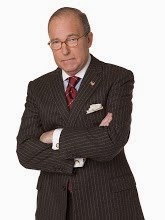
My interview with retired four-star Army General Jack Keane, where he points out mistakes of the new Obama/ISIS war policy.
Saturday, September 13, 2014
Thursday, July 17, 2014
Kudlow Testimony for the U.S. Congress Joint Economic Committee
THE RECOVERY AT FIVE YEARS
July 15, 2014
July 15, 2014


Friday, June 13, 2014
Announcing "Money and Politics" Podcast with Larry Kudlow & Governor Tim Pawlenty
Every Tuesday at www.nationalreview.com

Wednesday, May 28, 2014


Friday, May 23, 2014
Larry Kudlow: VA Scandal Shows Perils of Socialized Medicine
Larry was recently interviewed by "The Steve Malzberg Show" on Newsmax TV
The scandal rocking the
Veterans Health Administration should serve as a warning as to what can happen
under the Affordable Care Act, renowned economist and syndicated columnist
Larry Kudlow says.
This is not simply a management
problem," Kudlow, author of the CNBC blog "Kudlow's Corner,'' told
"The Steve Malzberg Show" on Newsmax TV.
"This is about a pocket of
government-run socialized medicine with rationing and price controls and the
usual bureaucratic inefficiencies. That's the problem with the VA.''
The VA is under fire for
allegedly keeping chronically-ill patients on a secret-waiting list — resulting
in the deaths of at least 40 veterans.
Additionally, there are
allegations of false record-keeping to cover up the scandal. "It is not a
money problem. The money going to the VA has exploded in recent years. In fact,
from 2000 to 2013, budget outlays tripled while the veterans' population being
served has actually declined by four million,'' Kudlow said.
"There's a problem with
government-run healthcare and [this] should be a lesson to all of us about the
dangers of Obamacare and single-payer insurance and so forth and so on."
Kudlow also called on Republicans to back a "sensible'' immigration reform
bill or risk losses at the polls.
"Sensible immigration
reform will really be pro-growth. It can really help America and can really
help the Republican Party put a different face on and reach out not just to Latinos,''
Kudlow said.
"This is symbolic,
immigration reform — symbolic reaching out to Asians, to African-Americans, to
young people, to women, and it says the Republican Party can in fact be a big
tent. "Its policies don't have to echo the Democrats, but there's a
reach-out factor here that I think is very, very important.'' Kudlow said that
doesn't mean unbridled citizenship or blanket amnesty.
"They have to go through a process and I think that's very, very important. I don't want them put at the front of the line for citizenship. I'm not really even talking about citizenship right now. I'm talking about legal status.
"[Sen.] Rand Paul [of Texas] has come out for legal status in a similar way, so has [Texas] Gov. Rick Perry, so has former [Florida] Gov. Jeb Bush. I like the direction here.''
Kudlow said it is also important to attract immigrant "brainiacs" as well as students and blue-collar workers.
"We need the high-tech electric engineers, all the Silicon Valley people. We need the foreign students we're educating. Why should we send them home? Why not keep them here?" he said.
"We need the low-end workers. That's what the Farmers Association and the Retailers Association are telling us. In other words, we need legal immigration.
"We need legal visa increases. If we do that, the more population will expand and increase economic growth. It's real simple. Population times productivity equals growth.''
Kudlow pointed to the low number of immigrants who supported Republican presidential candidate Mitt Romney in 2012.
"Twenty-seven percent of Asians voted for Mitt Romney, 27 percent of Hispanics voted for Mitt Romney. The GOP cannot win with those kinds of numbers," he said.
"If the party has a sensible policy and puts its best foot forward with the kind of principles that I'm encouraging here, it will make an impact.
"I am a conservative Catholic and all that goes with that, but I am willing to work in the same big tent as my friends from the Log Cabin Republicans. I believe that kind of attitude, which is an open inclusionary attitude, is missing from the GOP and must change.''
With that, the negative perception of the GOP will change, he believes.
"Right now, the GOP has a bad image. It’s an image of cranky white men and women. That image has to change,'' Kudlow said.
Sunday, March 30, 2014
Saturday, March 29, 2014
Friday, March 28, 2014
CNBC's 'Kudlow Report' Bids Adieu on Friday, March 28, 2014
by Newsmax Reporter, Todd Beamon
After 25 years of interviews and commentaries on everything from
Obamacare to supplyside economics, Larry Kudlow is retiring from fulltime
work at CNBC Friday — ending his awardwinning "The Kudlow Report"
and becoming a senior contributor to the cable network.
Kudlow, 66, will contribute to the "Business Day" program on CNBC. The
network announced his retirement from the daily primetime show earlier
this month.
A columnist and radio program host, Kudlow is a regular guest on "The
Steve Malzberg Show" on Newsmax TV.
Undergirded by "The Kudlow Creed" — "We believe that free market
capitalism is the best path to prosperity!" — the CNBC show began in
January 2009 and offered a mixture of politics and business. It has featured
interviews with a wide range of politicians, economists, Wall Street titans,
and media personalities.
The program succeeded "Kudlow & Company," which aired from 2005 until
October 2008. Before that, starting in 2002, the program was called
"Kudlow & Cramer" — with investment guru Jim Cramer as cohost. From
2001 to 2002, the program was called "America Now."
Over the years, Kudlow has hosted such guests as former President
George W. Bush, former Vice President Dick Cheney, former Secretary of
State Henry Kissinger, and current Defense Secretary Chuck Hagel.
He also has talked with such business leaders as media mogul Barry Diller
and energy investor T. Boone Pickens.
For instance, Thursday's program featured interviews with Republican Gov.
Scott Walker of Wisconsin — and he was joined by Cramer to discuss ways
to keep the American economy growing. Cramer now hosts "Mad Money"
on CNBC.
"Larry, I miss you," Cramer said, extending his hand. "You were the place
for civil discourse, because you are a civil man. We ended every show the
same way — and we do it now.
"You're the best," Kudlow responded. "You're the best."
He then turned to camera: "Jim Cramer, my expartner — and I miss him."
"This is not the end of Larry Kudlow in the public eye, it's just a new
beginning," Newsmax CEO Christopher Ruddy said. A longtime friend of
Kudlow, Ruddy added, "Larry will continue to carry the torch for
Reaganomics and the free market like no one else as he has for decades."
Ruddy noted that Kudlow played a key role as an adviser to President Ronald
Reagan in "unleashing the greatest economic boom the world has ever known."
Story continues below video.
The program also included tributes from such guests over the years as
NBC News White House correspondent Chuck Todd, Illinois GOP Rep.
Peter Roskam, and wealthmanagement company CEO Jack Bouroudjian.
Under Reagan, Kudlow served in the Office of Management and Budget.
He also worked as chief economist at Bear Stearns on Wall Street, and
served as an economist for the Federal Reserve Bank of New York.
A Man In The Arena (tribute to Larry Kudlow)
Thank you, Jason Trennert (CIS at Strategas Research Partners) for your beautiful tribute to Larry Kudlow:
All good things, as they say, must come to an end and tonight, I’m afraid, will mark the final installment of Larry Kudlow’s eponymous show The Kudlow Report on CNBC. I had long been a fan of Larry from his days on The McLaughlin Report when the sum total of political commentary on television was, mercifully now that I think about it, reserved for Sunday morning. (For you youngsters out there, the sum total of market commentary on television was reserved for a half-hour a week on Louis Rukeyeser’s Wall $treet Week and in truth, it’s hard not to feel as if we were the better for it.) I always admired Larry’s unapologetic defense of free markets and, to be frank, his style. He always looked, dressed, and spoke like a Wall Street guy should, I thought. I have considered a great blessing to have become friends with him and for his willingness to support my development as an economist and as a Wall Street professional as well as to shape my thoughts on the way markets and the economy work.
Perhaps we’ve gotten along so well because he too started his life as a Democrat. For me that changed after spending precisely one semester in Marion Barry’s Washington D.C. For Larry, that seemed to change after he began his career on the open market desk of the Federal Reserve Bank of New York and, after a stint on Wall Street, became the associate director for economics and planning in the Office of Management and Budget (OMB) in the first Reagan administration. He really became a star when he rejoined Bear Stearns as its Chief Economist in 1987 and his association with The McLaughlin Group flourished. Eleanor Clift never saw it coming.
We all stumble, of course, and it’s doubly hard to stumble publicly. Larry’s ability to craft a second career as a journalist and remain a fixture on CNBC for more than 12 years was due, in my view, to his intelligence, his unflagging optimism about this country, and his commitment to his Catholic faith and to his wife Judy. It all started in the immediate aftermath of 9/11 with America Now which he co-hosted with Jim Cramer. That show morphed eventually into The Kudlow Report and has remained a regular stop for those who intersect at the country’s two major power centers – Washington and Wall Street ever since. For those who doubt the power of an individual voice to have an influence, it should be remembered that Larry almost single-handedly gave President Bush the intellectual cover to cut taxes on both dividends and capital gains at a time when it was a politically unpopular. (While there may be questions about priorities, I have yet to hear a good economic rationale for the double taxation of dividends.) Commented The New York Times at the time, “All summer long on his program, which is watched by White House officials (although not President Bush), Mr. Kudlow hammered at the idea of dividend tax cuts. At the same time, conservative economists kept up the pressure on the White House.”[1] <#_ftn1> What was most significant about the tax cuts on dividends and capital gains at the time, was not only the fact that the rates were lowered but they were made equal, significantly diminishing the incentive for executives to seek capital gains over dividends. Larry will remain a contributor at CNBC and if someone’s awake over there they’ll have him recreate Lou Rukeyeser’s Wall $treet Week in his own image. In thinking about Larry’s career I am reminded of Teddy Roosevelt’s famous words:
“It is not the critic who counts; not the man who points out how the strong man stumbles, or where the doer of deeds could have done them better. The credit belongs to the man who is actually in the arena, whose face is marred by dust and sweat and blood; who strives valiantly; who errs, who comes short again and again, because there is no effort without error and shortcoming; but who does actually strive to do the deeds; who knows great enthusiasms, the great devotions; who spends himself in a worthy cause; who at the best knows in the end the triumph of high achievement, and who at the worst, if he fails, at least fails while daring greatly, so that his place shall never be with those cold and timid souls who neither know victory nor defeat.”
Keep up the good fight my friend.
Monday, December 23, 2013
Wednesday, November 20, 2013
Tuesday, October 29, 2013
Congressman Paul Ryan: "Obamacare Not Workable"
Obamacare’s glitches are here to stay according to House
Budget Committee Chairman Paul Ryan.
In an exclusive interview with CNBC’s Larry Kudlow, set to
air Tuesday night on “The Kudlow Report,” Ryan said the problems with the
Affordable Care Act extend far beyond website malfunctions.
“It’s more than the website,” Ryan said. “It’s because this
law itself is built from an architecture, a foundation, that’s just not
workable.”
Ryan said he sat through several House Committee Oversight
meetings in which the administration failed to answer fundamental questions on
the rollout of the Affordable Care Act.
“The point is they said ‘everything is fine, the law is
going to be OK. We are ready to roll it out. We won’t have any problems.’”
But House Republicans knew better, Ryan said.
“People should know that we tried to prevent this from happening
in the first place by fighting a law we did not intend,” Ryan said, referring to the Republican-led House’s 46
attempts to repeal the law.
“Then we tried giving people relief from the law by
delaying it until 2013. That was rejected and now we are living with this law.”
Frustrated with the Senate’s rejection of attempts to
defund and delay the law, Ryan shifted to the GOP’s most plausible tactic to
end the Affordable Care Act: winning elections.
“We owe the American people an alternative,” Ryan said. “We
want to win elections by saying this is not working for you and there are
better ways in keeping with the country’s principles that puts you in charge of
your heath care future.”
Ryan dismissed criticism that the Republican Party is at a
“civil war” after failed attempts to delay Obamacare as part of the government
shutdown and debt ceiling negotiations.
“We’ve had disagreements with each other on tactics,” he
said. “These aren’t principles. I don’t know a Republican that doesn’t support
comprehensive reforms to replace Obamacare with patient-centered health care.”
The Wisconsin Congressman said the GOP will have a chance
to showcase their common principles in budget negotiations set to begin
Wednesday.
He rejected hopes for a “grand bargain” deal, which he said
would include pro-growth tax reform, a balanced budget and entitlement reform.
“I don’t think we’ll get a grand bargain, and we’re not
talking about getting a grand bargain,” he said. “Because then, one party will
require that the other compromise their core principles, and we won’t get
anything done.”
The GOP’s key bargaining chip, Ryan said, is the
sequestration, the automatic spending cuts Democrats are seeking to repeal.
“If we can’t get anything better than the sequester, then
we’ll keep the sequester,” Ryan said. “That’s our base case to begin with.”
Ryan insisted increased tax revenue was out of the
question, calling Keynesian stimulus programs “sugar-high economics.”
“We’re not in this business to raise taxes,” he said.
“We’ll take the spending cuts we have and work with those.”
Instead, he said he was willing to negotiate on the
“smarter” cuts to replace sequestration.
“If we get a down payment on this debt and deficit in
exchange for short-term relief, we’ll take it,” he said. “But it has to be on
net a positive, meaning we will take the spending cuts right now.”
Ryan said substituting entitlement reform in place of broad
spending cuts under sequestration would enable long-term growth in the U.S.
economy.
“If smart entitlement reforms could replace this crude
across-the-board sequester, it would do a couple things,” Ryan said. “It would
show the world that America is getting ahead of its problems. We’re not just
going to victims of circumstances. We’re not just going to fall into a debt
crisis like Europe, but we’re going to get out of it.”
Entitlement should be at the top of the budget agenda, Ryan
said.
“The question is not if we deal with entitlements,” Ryan
said. “The question is if we are going to do it before the debt crisis or after
the debt crisis. We would like to do it before so that we can shape events in
this country instead of having events shape us.”
The Congressman said, ultimately, his job is to find common
ground in budget negotiations among Republicans and Democrats.
“I would argue that in this very difficult time that we are
in, wouldn’t it be nice to show that this American divided government can at
least govern?”
Thursday, October 10, 2013
Larry Kudlow & Robert Reich on CNN's "Piers Morgan Live"
With the government shutdown handicapping the nation, and the debt ceiling deadline rapidly approaching, Piers Morgan asked Robert Reich and Larry Kudlow to offer their vast insight and perspective.
Thursday, October 03, 2013
Tuesday, September 24, 2013
Kudlow's Lament: Is capital on strike in the U.S.? (written by Marc Wiersum of the Market Realist)
Investment in the United States
The below graph reflects the capital strike in fixed domestic investment in the United States. The “strike” of U.S. capital is the notion raised by CNBC commentator Larry Kudlow that despite record profits at U.S. companies, profits and capital aren’t recycling back into the U.S. economy as investment. As displayed below, U.S. corporate profits (the red line) were approximately 45% of total investment in the United States during the Reagan era in the 1980s. However, corporate profits now represent 85% of total investment in the United States—or nearly twice the historical levels. The most disturbing part of this trend is that despite the dramatic recovery in corporate profits post–2008 crisis, there hasn’t been an offsetting growth in investment in the United States.

What is fixed investment and why is it important?
“Fixed investment” refers to fixed capital investment, including the replacement of depreciated fixed capital. Fixed investment doesn’t include financial assets such as bonds. Fixed investment, from an accounting perspective, includes physical assets held one year or more. Fixed investment is important because the level of fixed investment indicates potential longer-term economic growth and future productivity gains. The more fixed capital available per worker, the more each worker can produce. When fixed capital growth rates decline, productivity and economic growth rates are more likely to slow in the future. Fixed investments include items such as machinery, land, buildings, installations, vehicles, and technology. In the 1980s, fixed investment stood at approximately 20% of U.S. dross domestic product, or GDP, though it’s now closer to 15% of U.S. GDP.
To continue . . .
http://marketrealist.com/2013/09/kudlows-lament-capital-strike-u-s/
Tuesday, July 09, 2013
Roger Stone's Sixth Annual Ten Best and Worst Dressed Men and Women in the World in 2012
In his fourth year on the StoneZone best dressed list, Kudlow, the supply-side apostle and pro-growth advocate who chews up the business news and lays down the Reaganite creed at CNBC has an uncanny sense of the "right" shirt and tie combinations for TV. The good taste of Turnbull & Asser, where Sean Connery got his shirts to be 007 is Kudlow's haberdasher of choice. Master Tailor Leonard Logsdail make his suits, somber, impeccable and quiet -- a canvas for his bold shirt and neckwear combinations.

http://www.huffingtonpost.com/roger-stone/best-worst-dressed-2012_b_2397538.html
http://www.huffingtonpost.com/roger-stone/best-worst-dressed-2012_b_2397538.html
Thursday, April 18, 2013
Tuesday, April 09, 2013
Thatcher, Freedom, and Free Markets

Many profound and detailed admiration pieces will be written about the late Margaret Thatcher, and they’ll be much deeper than this one.
But I want to get on record with my own esteem for Mrs. Thatcher, whose character, philosophy, and achievements made her one of Britain’s greatest prime ministers.
Way back in the early 1990s, at a National Review conference on the eastern shore of Maryland, had the great honor to serve on an economics panel that Mrs. Thatcher moderated. (Craig Roberts was also on that panel, although I can’t remember the name of the third panelist.) The topic was free markets and freedom, areas in which Margaret Thatcher made huge contributions, so I had a lot to live up to. And how did it go? Well, following the discussion, I got to sit next to Mrs. Thatcher during the luncheon. And she told me, “You know, Kudlow, you did rather well in that talk.” Naturally, I was thrilled.
Margaret Thatcher fought socialism in England and unyieldingly promoted the free-market views of Nobelists Milton Friedman and Friedrich Hayek. She stopped the destructive British labor unions dead in their tracks. With every bone in her body she attempted to limit government by lowering spending and taxation. She opted for big-bang financial deregulation. And she put London back on the map as a world banking center.
“Freedom” was always her watchword.
She also adored Ronald Reagan. And the two of them formed an extraordinary partnership for freedom and free markets. Working together they helped bring down the Soviet communist system. And it was a peaceful bring-down at that.
Thatcher saw Gorbachev first, and she reported to Reagan, “We can do business with him.” Reagan did, although he refused to back down on SDI. And as the American economy roared in response to Reagan’s own free-market supply-side policies, the Soviets were out-produced and eventually folded.
Mrs. Thatcher famously said, “The trouble with socialists is that they always run out of other people’s money.” That dictum really stands the test of time, doesn’t it? Running out of other people’s money? Today?
The age of big government has once again, at least temporarily, reared its ugly head. It’s a great battle for all the economies around the world. That’s one of many reasons why we will miss Margaret Thatcher. She did not go wobbly.
Wednesday, March 27, 2013
Kudlow's Radio Interview with Jimmy Kemp

Kemp: I’m great Larry, how are you?
Kudlow: I’m okay uh you know, there’s some scattered, you see some scattered columns and websites that talk about where’s the Jack Kemp, the new Jack Kemp in the Republican Party but, it was Jack’s message- I gave a talk, it was very funny, I gave a talk to the Wall people, the Manhattan, New York Republican Party and I’ve done this a little bit on the Kudlow Report, we had a whole Jack Kemp segment two nights ago-
Kemp: I saw it.
Kudlow: Alright, what I remember, let’s put the tax cuts aside for a minute, as important as they are, what I remember, particularly when Jack was the Secretary of HUD, because I was one of his volunteer kitchen cabinet there; Jack wanted Empowerment Zones-
Kemp: Enterprise Zones.
Kudlow: Enterprise Zones, tax free Enterprise Zones-
Kemp: Not tax credits, but tax free, you’re right.
Kudlow: and as much home ownership as possible for minority groups. Jack went to the projects, he actually went to the projects in Detroit, Chicago, L.A., and New York. He worked with Charlie Rangel, the great, black Congressman in New York City and we developed what became Empowerment Zones here in New York City. My wife’s art studio is in one, I mean am I wrong here? Is my memory betraying me?
Kemp: No, no of course not and part of what Dad understood is that- good policy, as great as Kemp-Roth was at cutting tax rates at that time, which was, reflecting on it, it was obvious tax rates were confiscatory. You couldn’t have them that high and have a growing economy. But he also knew at the same time, back in the 70’s, way before he was at H.U.D., but in order to have good policy it can only be policy that can be passed and in order to pass it he had to get Democrats. Larry, he was a Republican in a Democrat controlled House of Representatives and yet they had President Reagan in 1980, but he had to convince people, like Charlie Rangel, that he really did care. And that these policies that were “conservative,” he liked to call them liberal, because they were intended to free people to provide equal opportunity and knew that tax rates went along with providing that equality of opportunity in the housing sector, for people starting businesses in ghettos or barrios or poor urban areas, wherever they were. He knew that capitalism without capital is nothing but an ism, as Jesse Jackson had said and you had to get capital to people who would do something with it. He trusted people, and, as you pointed out, all people, not just rich folks who went to good schools.
Kudlow: See that’s the thing. Now the Republican Party is, some people in the Republican Party are trying to open up immigration reform. I’m all for it. Your dad believed that immigrants were a positive force.
Kemp: E pluribus unum.
Kudlow: Right. He would have been on the right side of that issue today. But, you know, Jimmy, It’s just like reaching out and saying okay we’re going to give you a green card, that’s not really the answer. I mean what I’m saying is Jack Kemp had a set of policies, besides low tax rates, he had ownership policies, he had empowerment policies, he had, let’s see, no capital gains tax if you moved a business into an Empowerment Zone, which would attract capital and people. There was human capital and financial capital. Kemp visited the projects, I want to emphasize it, Kemp met with La Raza Hispanics. Kemp visited the projects. When we were negotiating back in , I don’t know when this was Jimmy, 1991, Jack sent me to a couple of meetings with La Raza with his Rep. to try to figure out how to get a zero capital gains tax and La Raza backed it. They actually backed it. Now, Republicans don’t do that anymore. They don’t show up in the projects, they don’t go to a La Raza meeting, they don’t get photographed with Hispanic leaders and black leaders anymore. That was stuff Kemp did, it was great stuff. Why doesn’t anybody do that now, follow his example
Kemp: Well, the greatest example and a guy we all love and respect, Paul Ryan, who worked for Dad. H made the calculated decision to focus on our incredible budget deficit and the spending that was out of control in the entitlement programs and led, Larry as you know, it took him away from the main thrust of Dad’s career. And there isn’t anybody who has jumped into that, really opportunity, the way that Dad took the reins, and there are a lot of great leaders today. I’m not discouraged. Part of our purpose at the Kemp Foundation is to help support or political leaders and we’re certainly not pessimistic because we certainly couldn’t have the name Kemp associated with us if we were. You’ve got governors who are doing the right thing, you’ve got plenty of congressmen and senators, but we do need a more robust discussion of the components of an economic policy because there should never be any discussion of a new normal, I know you hate that phrase. This country has too much capability and abilities, not only in the board rooms, but in classrooms around the country.
Kudlow: Growth should be unlimited. Just to reset the table, we’re talking to Jimmy
Kemp who is the president of the Jack Kemp Foundation. I am holding up, you see these stories about Jack Kemp, one story was written, “We need entrepreneurs like Jack Kemp.” Okay, I’m fine with that, but I don’t want to miss the essential point here, the essential point; Jack’s goal was growth, in other words, if you grew the economy rapidly through lower tax rates, less regulation and sound money, if you grew the economy that was a weapon to shrink the budget deficit and the debt. That was Jack’s way out. That didn’t mean he’d vote for spending bills that were unnecessary, but he understood that debt to GDP, that Republicans obsess about all the time, you solve that, in some sense, by growing the GDP.
Kemp: Sure, you want a bigger pie.
Kudlow: Bigger pie! And secondly, with the debate about so called Republican outreach to minorities look at what Kemp did. Kemp didn’t do it just to win votes, he had a program. Let’s go through it again, it was home ownership, it was enterprise zones, it was tax-free enterprise zones. He would go to the meetings and the rallies and meet with the leadership. He already showed the way. What we need is a Kemp biography here to let people read this stuff and that’s what he did, he was a one-man band. Some Republicans made fun of him, the country club crowd made fun of him, Jimmy, but we should follow his lead now.
Kemp: Well, yeah, the Kemp Foundation has a biography in the works and then we’re also releasing, in 2013, all of his speeches, which were previously released in a volume called the American Idea. And American Renaissance, we’re going to put out as well. The American Idea will have all of the speeches that were in it previously, but a bunch added to it.
Kudlow: Who’s doing the biography Jimmy? We only have 25 seconds. Who’s doing the Biography Jimmy?
Kemp: We’ve got Mort Kondracke and Fred Barnes working on it.
Kudlow: I did the oral history. I want to see that. I want to work on that biography.
Kemp: Alright.
Kudlow: Jimmy Kemp, president of the Jack Kemp Foundation. That was Jack Kemp’s message, hope and opportunity for everybody, including minorities. I’m Larry Kudlow and we’ll be back with some budget talk on the other side of the break.
Subscribe to:
Posts (Atom)