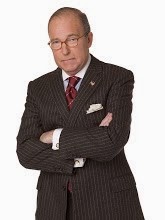
Kudlow: I was talking about Jack Kemp my mentor, the late Jack Kemp, the great Jack Kemp, my friend and mentor, and his great message of economic growth and opportunity for all. I want to emphasize those last two words- for all. Nobody, in my lifetime, in either party, has reached out with a message of hope, growth and opportunity to minorities better than Jack Kemp. And I want to bring in my pal, Jimmy Kemp, who runs the Jack Kemp Foundation because, Jimmy is now the keeper of the scrolls and he is also a great friend. Jim, how are you buddy?
Kemp: I’m great Larry, how are you?
Kudlow: I’m okay uh you know, there’s some scattered, you see some scattered columns and websites that talk about where’s the Jack Kemp, the new Jack Kemp in the Republican Party but, it was Jack’s message- I gave a talk, it was very funny, I gave a talk to the Wall people, the Manhattan, New York Republican Party and I’ve done this a little bit on the Kudlow Report, we had a whole Jack Kemp segment two nights ago-
Kemp: I saw it.
Kudlow: Alright, what I remember, let’s put the tax cuts aside for a minute, as important as they are, what I remember, particularly when Jack was the Secretary of HUD, because I was one of his volunteer kitchen cabinet there; Jack wanted Empowerment Zones-
Kemp: Enterprise Zones.
Kudlow: Enterprise Zones, tax free Enterprise Zones-
Kemp: Not tax credits, but tax free, you’re right.
Kudlow: and as much home ownership as possible for minority groups. Jack went to the projects, he actually went to the projects in Detroit, Chicago, L.A., and New York. He worked with Charlie Rangel, the great, black Congressman in New York City and we developed what became Empowerment Zones here in New York City. My wife’s art studio is in one, I mean am I wrong here? Is my memory betraying me?
Kemp: No, no of course not and part of what Dad understood is that- good policy, as great as Kemp-Roth was at cutting tax rates at that time, which was, reflecting on it, it was obvious tax rates were confiscatory. You couldn’t have them that high and have a growing economy. But he also knew at the same time, back in the 70’s, way before he was at H.U.D., but in order to have good policy it can only be policy that can be passed and in order to pass it he had to get Democrats. Larry, he was a Republican in a Democrat controlled House of Representatives and yet they had President Reagan in 1980, but he had to convince people, like Charlie Rangel, that he really did care. And that these policies that were “conservative,” he liked to call them liberal, because they were intended to free people to provide equal opportunity and knew that tax rates went along with providing that equality of opportunity in the housing sector, for people starting businesses in ghettos or barrios or poor urban areas, wherever they were. He knew that capitalism without capital is nothing but an ism, as Jesse Jackson had said and you had to get capital to people who would do something with it. He trusted people, and, as you pointed out, all people, not just rich folks who went to good schools.
Kudlow: See that’s the thing. Now the Republican Party is, some people in the Republican Party are trying to open up immigration reform. I’m all for it. Your dad believed that immigrants were a positive force.
Kemp: E pluribus unum.
Kudlow: Right. He would have been on the right side of that issue today. But, you know, Jimmy, It’s just like reaching out and saying okay we’re going to give you a green card, that’s not really the answer. I mean what I’m saying is Jack Kemp had a set of policies, besides low tax rates, he had ownership policies, he had empowerment policies, he had, let’s see, no capital gains tax if you moved a business into an Empowerment Zone, which would attract capital and people. There was human capital and financial capital. Kemp visited the projects, I want to emphasize it, Kemp met with La Raza Hispanics. Kemp visited the projects. When we were negotiating back in , I don’t know when this was Jimmy, 1991, Jack sent me to a couple of meetings with La Raza with his Rep. to try to figure out how to get a zero capital gains tax and La Raza backed it. They actually backed it. Now, Republicans don’t do that anymore. They don’t show up in the projects, they don’t go to a La Raza meeting, they don’t get photographed with Hispanic leaders and black leaders anymore. That was stuff Kemp did, it was great stuff. Why doesn’t anybody do that now, follow his example
Kemp: Well, the greatest example and a guy we all love and respect, Paul Ryan, who worked for Dad. H made the calculated decision to focus on our incredible budget deficit and the spending that was out of control in the entitlement programs and led, Larry as you know, it took him away from the main thrust of Dad’s career. And there isn’t anybody who has jumped into that, really opportunity, the way that Dad took the reins, and there are a lot of great leaders today. I’m not discouraged. Part of our purpose at the Kemp Foundation is to help support or political leaders and we’re certainly not pessimistic because we certainly couldn’t have the name Kemp associated with us if we were. You’ve got governors who are doing the right thing, you’ve got plenty of congressmen and senators, but we do need a more robust discussion of the components of an economic policy because there should never be any discussion of a new normal, I know you hate that phrase. This country has too much capability and abilities, not only in the board rooms, but in classrooms around the country.
Kudlow: Growth should be unlimited. Just to reset the table, we’re talking to Jimmy
Kemp who is the president of the Jack Kemp Foundation. I am holding up, you see these stories about Jack Kemp, one story was written, “We need entrepreneurs like Jack Kemp.” Okay, I’m fine with that, but I don’t want to miss the essential point here, the essential point; Jack’s goal was growth, in other words, if you grew the economy rapidly through lower tax rates, less regulation and sound money, if you grew the economy that was a weapon to shrink the budget deficit and the debt. That was Jack’s way out. That didn’t mean he’d vote for spending bills that were unnecessary, but he understood that debt to GDP, that Republicans obsess about all the time, you solve that, in some sense, by growing the GDP.
Kemp: Sure, you want a bigger pie.
Kudlow: Bigger pie! And secondly, with the debate about so called Republican outreach to minorities look at what Kemp did. Kemp didn’t do it just to win votes, he had a program. Let’s go through it again, it was home ownership, it was enterprise zones, it was tax-free enterprise zones. He would go to the meetings and the rallies and meet with the leadership. He already showed the way. What we need is a Kemp biography here to let people read this stuff and that’s what he did, he was a one-man band. Some Republicans made fun of him, the country club crowd made fun of him, Jimmy, but we should follow his lead now.
Kemp: Well, yeah, the Kemp Foundation has a biography in the works and then we’re also releasing, in 2013, all of his speeches, which were previously released in a volume called the American Idea. And American Renaissance, we’re going to put out as well. The American Idea will have all of the speeches that were in it previously, but a bunch added to it.
Kudlow: Who’s doing the biography Jimmy? We only have 25 seconds. Who’s doing the Biography Jimmy?
Kemp: We’ve got Mort Kondracke and Fred Barnes working on it.
Kudlow: I did the oral history. I want to see that. I want to work on that biography.
Kemp: Alright.
Kudlow: Jimmy Kemp, president of the Jack Kemp Foundation. That was Jack Kemp’s message, hope and opportunity for everybody, including minorities. I’m Larry Kudlow and we’ll be back with some budget talk on the other side of the break.
Wednesday, March 27, 2013
Tuesday, March 26, 2013
Wednesday, March 13, 2013
Thursday, March 07, 2013
Speaker Boehner Wants Budget Deals 'Out In The Open'
House Speaker John Boehner told me on Wednesday that a long-term deal on entitlements is possible, and also that there's no good reason for Team Obama to shut down the White House tour. As the mandatory budget cuts continue to take effect, Boehner said he believes the American people still know that Washington primarily has a spending problem.
The speaker insisted that the president still doesn't understand that spending is the real issue, although he was more optimistic about Obama's offers to reform entitlements. He also said he believes talk of limiting Social Security benefit increases and "means testing" Medicare to disqualify the wealthiest senior is for real, and that these items could be a basis for a grand bargain with the president.
But the Republican speaker made it clear that he wants to move budget negotiations out of the back rooms and in front of the broader congress and the American people.
"The top-down deals haven't worked out too well," he said during the exclusive Kudlow Report interview, adding that the process needs to be "more out in the open." And while he noted that he gets along well with Obama on a personal level, he said the budget process shouldn't be about their relationship anymore.
The speaker also stepped into the controversy now swirling in Washington over the decision to shut down White House tours because of the sequester cuts. Boehner said, "The president is trying to make it tough on members of Congress. It's just silly. I want to know who is being laid off at the White House. The Capitol is open for tours. We've been planning for this for months."
Boehner closed the interview by telling me that he's "still on a mission," and that he intends to stick around as speaker for a while. He also me announced that he is launching a new comment feature on www.speaker.gov that offers average Americans a chance to weight in on government spending.
View our two-part interview below:
The speaker insisted that the president still doesn't understand that spending is the real issue, although he was more optimistic about Obama's offers to reform entitlements. He also said he believes talk of limiting Social Security benefit increases and "means testing" Medicare to disqualify the wealthiest senior is for real, and that these items could be a basis for a grand bargain with the president.
But the Republican speaker made it clear that he wants to move budget negotiations out of the back rooms and in front of the broader congress and the American people.
"The top-down deals haven't worked out too well," he said during the exclusive Kudlow Report interview, adding that the process needs to be "more out in the open." And while he noted that he gets along well with Obama on a personal level, he said the budget process shouldn't be about their relationship anymore.
The speaker also stepped into the controversy now swirling in Washington over the decision to shut down White House tours because of the sequester cuts. Boehner said, "The president is trying to make it tough on members of Congress. It's just silly. I want to know who is being laid off at the White House. The Capitol is open for tours. We've been planning for this for months."
Boehner closed the interview by telling me that he's "still on a mission," and that he intends to stick around as speaker for a while. He also me announced that he is launching a new comment feature on www.speaker.gov that offers average Americans a chance to weight in on government spending.
View our two-part interview below:
Thursday, January 31, 2013
The Spending Sequester Will Grow the Private Economy
Today’s report of a 0.1 percent GDP decline for the fourth quarter came as a surprise to most forecasters. But it actually masks considerable strength in the private economy. Namely, housing investment in the fourth quarter jumped 15.3 percent annually, business equipment and software spiked 12.4 percent, and real private final sales rose 2.6 percent. All in, the domestic private sector of the economy increased 3.4 percent annually -- a very respectable gain.
And here’s one for the record books: Working ahead of year-end tax hikes, individuals shifted so much money to the fourth quarter at the 35 percent top rate that personal income grew by 7.9 percent annually -- a huge number. And there’s more: In order to beat the tax man, dividend income rose 85.2 percent annually. You think tax incentives don’t matter? Guess again.
Now, all this private-sector strength occurred despite the fact that government spending -- namely military spending -- dropped 6.6 percent. Inventories also lost ground and the trade deficit widened.
But here’s a key point: Military spending has now fallen virtually to its lower sequester-spending-cut baseline. It did so in one quarter by about $40 billion. So the brunt of the impact over the coming years has already been felt. (Normally, as of recent years, military spending has been virtually flat.)
Which leads me to another key point: Even with the fourth-quarter contraction, the latest GDP report shows that falling government spending can coexist with rising private economic activity. This is an important point in terms of the upcoming spending sequester. Lower federal spending, limited government, and a smaller spending-to-GDP ratio will be good for growth. The military spending plunge will not likely be repeated. But by keeping resources in private hands, rather than transferring them to the inefficient government sector, the spending sequester is actually pro-growth.
Big-government Keynesians think big spending provides big growth. They are wrong. This has been a 2 percent recovery -- the worst in modern times -- dating back to 1947. So let’s try something different. Let’s shrink government. Let’s let the private sector breathe and generate entrepreneurship and risk-taking.
Spending is the true tax measure of the economy, according to Milton Friedman, Friedrich Hayek, and others. Even a modest sequester spending cut of maybe $60 billion in 2013, and perhaps more than $1 trillion over ten years (most of which will come from a slower spending growth rate, not real reductions), will be the best thing to inspire business and market confidence as well as international credibility. And it maybe even shave a point or two off the spending share of GDP.
On March 1 the spending sequester is supposed to kick in by law. If Congress wants to help the U.S. economy, the best thing it can do right now is implement this sequester. Then it can round out an even larger growth package, including large- and small-business tax reform and adjustments to stop entitlements from going bankrupt.
And here’s one for the record books: Working ahead of year-end tax hikes, individuals shifted so much money to the fourth quarter at the 35 percent top rate that personal income grew by 7.9 percent annually -- a huge number. And there’s more: In order to beat the tax man, dividend income rose 85.2 percent annually. You think tax incentives don’t matter? Guess again.
Now, all this private-sector strength occurred despite the fact that government spending -- namely military spending -- dropped 6.6 percent. Inventories also lost ground and the trade deficit widened.
But here’s a key point: Military spending has now fallen virtually to its lower sequester-spending-cut baseline. It did so in one quarter by about $40 billion. So the brunt of the impact over the coming years has already been felt. (Normally, as of recent years, military spending has been virtually flat.)
Which leads me to another key point: Even with the fourth-quarter contraction, the latest GDP report shows that falling government spending can coexist with rising private economic activity. This is an important point in terms of the upcoming spending sequester. Lower federal spending, limited government, and a smaller spending-to-GDP ratio will be good for growth. The military spending plunge will not likely be repeated. But by keeping resources in private hands, rather than transferring them to the inefficient government sector, the spending sequester is actually pro-growth.
Big-government Keynesians think big spending provides big growth. They are wrong. This has been a 2 percent recovery -- the worst in modern times -- dating back to 1947. So let’s try something different. Let’s shrink government. Let’s let the private sector breathe and generate entrepreneurship and risk-taking.
Spending is the true tax measure of the economy, according to Milton Friedman, Friedrich Hayek, and others. Even a modest sequester spending cut of maybe $60 billion in 2013, and perhaps more than $1 trillion over ten years (most of which will come from a slower spending growth rate, not real reductions), will be the best thing to inspire business and market confidence as well as international credibility. And it maybe even shave a point or two off the spending share of GDP.
On March 1 the spending sequester is supposed to kick in by law. If Congress wants to help the U.S. economy, the best thing it can do right now is implement this sequester. Then it can round out an even larger growth package, including large- and small-business tax reform and adjustments to stop entitlements from going bankrupt.
Monday, January 07, 2013
One-on-One with Senator Ted Cruz
Last week on "The Kudlow Report", I asked Republican Senator Ted Cruz if he'd go with a government shutdown if it came to it on the debt-ceiling debate. His answer: "I think we have to be prepared to go so far as to shut the government down -- if we don't get some serious policies to stop the out-of-control spending, to tackle the debt, and to get economic growth."
It was a bold statement. Watch the full video here:
Wednesday, December 12, 2012
No Cliff Calamity: That's What Stocks Are Correctly Predicting
Despite all the media hullabaloo about the fiscal cliff and a potential recession if none of the Bush tax cuts are extended, stock markets have behaved calmly throughout this whole period. In fact, as of this writing today, the Dow is up 100 points.
I’m gonna guess that stocks, in their wisdom, are correctly sniffing that there will be no calamitous falling off the cliff. By that I mean there will be no $500 billion tax hike, which would be an economy killer.
Instead, after speaking with prominent Republican House and Senate members, I have come to believe the following: The GOP knows that Obama has the upper hand in this post-election battle. Therefore, they are preparing a strategic retreat.
Republicans don’t want to be the party of rich people and let Obama maintain his hold on the middle class. Republicans also don’t want to be the party of recession. So if no comprehensive deal is reached by President Obama and Speaker John Boehner, Republicans will not block an extension of the so-called middle-class tax cuts, which are roughly three quarters of the total.
It’s hard to know how this story will work itself out. There may be deals on upper-end tax rates, say 37 percent instead of 39.6 percent. And maybe even some lower tax penalties on capital gains and dividends.
Ideally, the GOP can get solid promises on spending cuts and entitlement reforms in return for a tax package. That tax package may include a dollar limit for tax deductions along with the rise in upper-end tax rates. Entitlement reform is also on the table. And so is a roughly $60 billion 2013 spending cut, which carries over from the across-the-board sequester. That is still possible.
But what is not possible is that House Republicans give up their constitutional prerogative to set the debt ceiling. That is their biggest point of leverage. And that leverage will carry over into 2013 as lawmakers once again attempt an across-the-board effort for pro-growth tax reform (flatter rates, broadening the base), serious structural entitlement reform, and more discretionary spending cuts. This will be the battle royale of next year.
As I said, no one knows how all this is going to play out in the next two weeks. But from the standpoint of the economy and the stock market, a worst-case tax-hike scenario that would sink GDP is not likely to happen.
There will be a deal to extend most of the tax cuts. And while higher tax rates on successful earners, small-business owners, and investors are most definitely not pro-growth, at least the across-the-board tax-hike calamity will be avoided.
I’m gonna guess that stocks, in their wisdom, are correctly sniffing that there will be no calamitous falling off the cliff. By that I mean there will be no $500 billion tax hike, which would be an economy killer.
Instead, after speaking with prominent Republican House and Senate members, I have come to believe the following: The GOP knows that Obama has the upper hand in this post-election battle. Therefore, they are preparing a strategic retreat.
Republicans don’t want to be the party of rich people and let Obama maintain his hold on the middle class. Republicans also don’t want to be the party of recession. So if no comprehensive deal is reached by President Obama and Speaker John Boehner, Republicans will not block an extension of the so-called middle-class tax cuts, which are roughly three quarters of the total.
It’s hard to know how this story will work itself out. There may be deals on upper-end tax rates, say 37 percent instead of 39.6 percent. And maybe even some lower tax penalties on capital gains and dividends.
Ideally, the GOP can get solid promises on spending cuts and entitlement reforms in return for a tax package. That tax package may include a dollar limit for tax deductions along with the rise in upper-end tax rates. Entitlement reform is also on the table. And so is a roughly $60 billion 2013 spending cut, which carries over from the across-the-board sequester. That is still possible.
But what is not possible is that House Republicans give up their constitutional prerogative to set the debt ceiling. That is their biggest point of leverage. And that leverage will carry over into 2013 as lawmakers once again attempt an across-the-board effort for pro-growth tax reform (flatter rates, broadening the base), serious structural entitlement reform, and more discretionary spending cuts. This will be the battle royale of next year.
As I said, no one knows how all this is going to play out in the next two weeks. But from the standpoint of the economy and the stock market, a worst-case tax-hike scenario that would sink GDP is not likely to happen.
There will be a deal to extend most of the tax cuts. And while higher tax rates on successful earners, small-business owners, and investors are most definitely not pro-growth, at least the across-the-board tax-hike calamity will be avoided.
Wednesday, November 14, 2012
Monday, November 12, 2012
Senator Kyl Sees Higher Revenues Without a Tax Hike
A federal budget deal to avoid the fiscal cliff can be achieved without
raising tax rates, Senate Minority Whip Jon Kyl said Friday on the Kudlow
Report.
“Tax revenues can be generated by two ways other than raising tax rates,” he
said. “One is to eliminate some of the deductions, credits, exemptions,
special provisions in the code that end up producing more revenue but
without affecting the rates. And the other is through economic growth.”
The senator from Arizona said he thought it likely a deal could be struck to avoid the so-called “fiscal cliff,” a deadline by which the lack of a federal budget would result in the expiration of the Bush tax cuts and trigger automatic spending cuts.
Kyl sees additional revenues as the key.
The senator from Arizona said he thought it likely a deal could be struck to avoid the so-called “fiscal cliff,” a deadline by which the lack of a federal budget would result in the expiration of the Bush tax cuts and trigger automatic spending cuts.
Kyl sees additional revenues as the key.
“If we can focus, not on tax rates, but to give the president something that he
wants, more tax revenues, as I said, there are ways to get more tax
revenues,” he said. “Either through and/or producing more wealth as a
country, thus resulting in more taxes paid to the government.”
The Republican senator also took issue with the recommendations of the
special committee co-chaired by former Sen. Alan Simpson, R-Wyo., and
former Clinton White House Chief of Staff Erskine Bowles.
“Simpson-Bowles is not a good template here because it sets up a contest
between lowering marginal tax rates and raising the business taxes, that is to
say, dividends, capital gains and the estate tax,” he said. “Simpson-Bowles
in effect says, you can have lower rates on one side or another, but not both.
That’s not good.”
Friday, October 26, 2012
Once Bullish, Leon Cooperman Grows Wary of Stock Valuations
For years famed investor Leon Cooperman has talked up stocks. But on last night’s show, he sounded the alarm.
Cooperman, who is a widely followed investor and chairman of the hedge fund Omega, has made headlines for quite some time calling stocks 'the best house in the financial asset neighborhood.'
Back in 2011, Cooperman outlined his pro-stock market thesis at length on CNBC.
But on The Kudlow Report, Cooperman made a surprising statement that presumably reflected a shift in his outlook. He told Larry, “I think the stock market presently is fairly valued. I believe the profit cycle is peaking.”
Cooperman went on to say that the market multiple may be too high.
“Historically the market multiple is around 15,”
said Cooperman, but over the past 50 years or so the growth rate has been much
more robust. If we’re moving into a period of slower growth than the premium
investors are willing to pay for stocks will probably decline.
That’s not to say Cooperman is a seller – he’s not. “I’m not aggressively bullish or bearish,” he explained, “I’m simply saying I think the market is now fairly valued.”
And he reiterated something he’s said many times before.
“If you must put money to work I still don’t think there’s a better alternative than common stocks – the Fed has made all the alternatives very unappealing."
Nonetheless, his commentary suggests his outlook is
shifting.
Cooperman also told Larry Kudlow that he thought all the concerns about the fiscal cliff or the confluence of tax hikes and spending cuts that could go into effect as soon as January 1st – are overblown.
“They’ll kick the can down the road,” he said. “There’s no way a politician will allow the cliff to hit.”
Cooperman also told Larry Kudlow that he thought all the concerns about the fiscal cliff or the confluence of tax hikes and spending cuts that could go into effect as soon as January 1st – are overblown.
“They’ll kick the can down the road,” he said. “There’s no way a politician will allow the cliff to hit.”
Thursday, October 25, 2012
Does the Fed Have Grave Concerns About the Economy?
On Tuesday, the Federal Reserve re-affirmed its commitment to using unconventional efforts to stimulate the economy.
In the latest Fed statement, the central bank said it would keep buying $40 billion in mortgage-backed debt per month to push interest rates lower.
The Fed also repeated its vow to keep interest rates near zero until mid-2015.
Although that may seem like the Fed is sending a signal to markets that they’re intent to drive the economy, no matter what the cost – that may not be what the Fed is really saying.
According to former Fed Governor Kevin Warsh the move isn’t a show of strength – it’s something far more ominous.
“I think the Fed revealed in their actions just how grave they think the economy is,” he said on The Kudlow Report.
The statement shows, “just how concerned they are about the economy’s prospects – just how concerned they are about the 'fiscal cliff' and Europe.”
Warsh served as a member of the Board of Governors of the Federal Reserve System from 2006 to 2011. From 2002 to 2006, Warsh was Special Assistant to the President for Economic Policy, and Executive Secretary of the National Economic Council.
His take on the Fed – as someone who was once on the inside – is that the Fed feels they’re the only institution standing between the nation and a terrible downturn.
“The central bankers feel their doing it all by themselves – that they’re not getting help from Congress or the administration.”
It seems Wall Street may share the skepticism expressed by Warsh. Again both the Dow and S&P closed lower.
Friday, September 28, 2012
Mitt's Tax Cut Mulligan
For some unknown reason, Mitt Romney dialed back his tax-cut plan yesterday, the same day new reports showed incomes are dropping.
Last month, median household income fell by about $500, and since Obama became president, income is down over $4,500. But under Mitt Romney’s 20 percent tax-cut plan, if he truly believes it and follows through with it, a married couple making $70,000 a year would save over $2,000. And take-home pay for a middle-class married couple earning about $140,000 -- with their tax rate dropping to 20 percent from 25 percent -- would increase by over $7,100. Obama has no such middle-class tax cuts.
So why would Governor Romney tell an Ohio crowd on Wednesday that they shouldn’t “be expecting a huge cut in taxes, ’cause I’m also going to lower deductions and exemptions.”
What is that all about? What kind of message is he sending? Is it pro-growth take-home pay? Or is he pulling back and hedging his bet?
I wrote in my last column about the potential benefits of the Romney plan. And I suggested that Romney should give specific examples of higher take-home pay from his tax cuts. And then I suggested that he draw a red line for middle-income taxpayers, and say “you will not lose you’re your deductions.” In other words, send a true growth message. And make it clear, not muddied.
This afternoon, one of the most senior people in the Romney-Ryan camp called me to say that Mitt misspoke, and that I should give him a mulligan. This person told me there’s no pull-back on the pro-growth tax-cut message, no new overemphasis on debt, and no departure from the Reagan-Kemp tradition.
Okay, even though I’m a tennis player, I’m willing to give Mr. Romney a mulligan. But I’ll say this: The growth message has to be crystal clear for the debate next Wednesday night. Mitt is slipping in the polls. People are confused about his message. He must clarify it.
Lower marginal tax rates. Higher middle-class take-home pay to offset lost income under Obama. More family financial resources. More growth and more jobs.
This doesn’t have to be so hard.
Last month, median household income fell by about $500, and since Obama became president, income is down over $4,500. But under Mitt Romney’s 20 percent tax-cut plan, if he truly believes it and follows through with it, a married couple making $70,000 a year would save over $2,000. And take-home pay for a middle-class married couple earning about $140,000 -- with their tax rate dropping to 20 percent from 25 percent -- would increase by over $7,100. Obama has no such middle-class tax cuts.
So why would Governor Romney tell an Ohio crowd on Wednesday that they shouldn’t “be expecting a huge cut in taxes, ’cause I’m also going to lower deductions and exemptions.”
What is that all about? What kind of message is he sending? Is it pro-growth take-home pay? Or is he pulling back and hedging his bet?
I wrote in my last column about the potential benefits of the Romney plan. And I suggested that Romney should give specific examples of higher take-home pay from his tax cuts. And then I suggested that he draw a red line for middle-income taxpayers, and say “you will not lose you’re your deductions.” In other words, send a true growth message. And make it clear, not muddied.
This afternoon, one of the most senior people in the Romney-Ryan camp called me to say that Mitt misspoke, and that I should give him a mulligan. This person told me there’s no pull-back on the pro-growth tax-cut message, no new overemphasis on debt, and no departure from the Reagan-Kemp tradition.
Okay, even though I’m a tennis player, I’m willing to give Mr. Romney a mulligan. But I’ll say this: The growth message has to be crystal clear for the debate next Wednesday night. Mitt is slipping in the polls. People are confused about his message. He must clarify it.
Lower marginal tax rates. Higher middle-class take-home pay to offset lost income under Obama. More family financial resources. More growth and more jobs.
This doesn’t have to be so hard.
Thursday, September 27, 2012
Just How Fragile is the U.S. Economy?
As if the looming "fiscal cliff" isn’t frightening enough, new results suggest it’s already doing very serious damage to the economy. And it’s only September.
According to a new survey released by the Business Roundtable, corporate America’s view of the economy is as bleak now as it was in 2009, when the economy was struggling to emerge from recession.
Also, the survey shows executives are now more likely to cut jobs over the next six months, and that companies are less likely to raise their capital spending.
Largely the CEOs who participated in the study cited the "fiscal cliff," or the confluence of tax hikes and spending cuts that could go into effect as soon as January 2013, as a major influence behind their decisions.
Dow Chemical CEO Andrew Liveris called the fiscal cliff a 'multiplier' that makes any negative catalyst that much worse.
As much as $500 billion in federal spending reductions and expiring tax cuts are due to take effect if Congress and the White House are unable to find a compromise on these issues by Dec. 31, 2012.
As a result, the CEOs also lowered their forecasts for U.S. economic growth.
“The government is failing us as a whole,” charged Liveris on The Kudlow Report. “This is self-inflicted uncertainty.”
They now expect real gross domestic product to rise 1.9 percent in 2012, down from a June forecast of 2.1 percent growth.
In turn, these concerns have already begun to ripple across the economy, and may in part explain the spate of lowered earnings forecasts from companies such as FedEx and Norfolk Southern.
The findings come less than two months ahead of the U.S. presidential election, in which the weak economy and stubbornly high unemployment are shaping up to be key elements in voters' choice between incumbent Democratic President Barack Obama and Republican challenger Mitt Romney.
The Romney campaign was quick to call out the results as a sign that Obama's economic policies were not working.
"Business leaders have the gloomiest outlook in three years and the President's failed economic policies of higher taxes and more regulations will only make things worse," spokesman Ryan Williams said in a statement.
The Obama campaign did not immediately respond to a request for comment.
“Whatever president and congress we get in November, it doesn’t matter. What matters is that we get one that gives us solutions,” said Liveris.
CEOs who participate in the Business Roundtable collectively generate $7.3 trillion in annual revenue and employ some 16 million people.
Friday, August 31, 2012
Romney Didn't Make the Sale
Did Mitt Romney make the economic sale at the Republican National Convention? Did he convince people who are living at the margin or unemployed and discouraged that he has the answers to the economy? Frankly, I don’t think so.
I do not understand why he did not talk about his 20 percent across-the-board personal tax cut plan that would help the middle class enormously. He never mentioned it and he went into no detail on the business tax cut plan.
This plan is terrific for competition and global investment. He talked about a jobs tour. I frankly have no idea what a “jobs tour” is. I do know that 23 million Americans need jobs. I don’t know that they need a president on a jobs tour to inspect them.
It concerns me that in the economic zone, he didn’t make the sale to the independents, so-called Reagan Democrats, or to Clinton Democrats. I didn’t hear anything new. I didn’t hear anything specific, and it troubles me. I do think he helped himself enormously with his biographical narrative. He came off as a humble, grateful man.
Again, on the economic front I don’t think he made the sale; I don’t think he convinced the independent voters and I don’t think he’s going in the right direction in tax policy.
ON BIG BUSINESS:
I think he needs to be more specific. It’s not about big business -- it’s really about small business. And guess what? Small businesses pay the personal tax rate — the LLCs and the S-corps. That is another reason why I don’t understand why he doesn’t talk about the 20 percent tax cut. It helps small businesses and it’s the opposite contrast to Obama, who wants to raise taxes on those people. I didn’t hear any contrast Thursday night, except a passage on success. The best line from an economic standpoint was “In America, we celebrate success, we don’t apologize for success." That is a great line, but I wish he had more contrast with President Obama.
ON MARCO RUBIO:
Sen. Marco Rubio’s introduction of Romney was one of the most brilliant speeches I have heard in a long time. Freedom was his key point. America is about freedom — economic freedom, political freedom, religious freedom, and faith. It was just utterly brilliant and the guy is an absolute Republican superstar.
Thursday, August 30, 2012
Paul Ryan's Speech: Too Much Debt, Not Enough Growth
Republican vice-presidential candidate Paul Ryan gave a powerful speech Wednesday that repeatedly brought conventioneers at the Republican National Convention in Tampa to their feet. I am going to give him high marks for his speech’s delivery.
Ryan, in typical fashion, seriously and analytically ripped apart the Obama Economy, what has been called Obamanomics. He ripped it to pieces, and it needed to be done. But most especially, he ripped apart Obamacare. Ryan also did his level best to defend the Republicans against the usual attacks on Medicare reform—that is, what the Democrats call “Mediscare”.
However, I was disappointed that his economic growth solutions were somewhat muddled and unclear. At one point in the speech, rather than speak about Mitt Romney’s own tax rate proposals, Ryan used the term “tax fairness,” a Democratic term frequently used by President Obama and other liberal Democrats. This was surprising to me. Ryan cited Jack Kemp and the Reagan tax reform (and I am, of course, part of that gang).
But the reality is, Ryan never mentioned tax cuts during his speech. Not the 20 percent across-the-board supply-side reduction in marginal tax rates, nor the 25 percent corporate tax rate down from 35 percent. These pro-growth measures have been proposed by Mitt Romney, but it is a mystery to me why Ryan did not mention them.
He dwelled on debt to an extreme point. I don’t think discussing debt connects with people who are unemployed or marginally employed. I think they want a good-paying job, and debt is almost an academic abstraction. When Republicans run on debt and deficits, they almost always lose. When Republicans run on growth, limited government, lower spending, lower tax rates, and de-regulation—they win. Ryan’s speech was confusing on the growth issue, and that was disappointing; I don’t want to be confused and the American people shouldn’t be confused.
It will be left to Mitt Romney on Thursday night to clarify his own growth policies. I want growth, growth, growth. Wednesday night, I didn’t get growth, growth, growth; I heard debt, debt, debt.
Tuesday, August 28, 2012
Friday, August 24, 2012
Kudlow Goes One-on-One with Paul Ryan
On last night’s Kudlow Report, Paul Ryan talked to me about pro-growth policies and the American idea. He defended his Medicare option as a bipartisan plan going back to the Clinton era. He talked supply-side tax reform, along with spending reduction, deregulation, energy, and sound money. Preventing the fiscal-cliff recession threat will be Romney-Ryan’s first action.
Wednesday, August 15, 2012
No July Recession
While the fiscal-cliff tax hike still hangs like the recessionary sword of Damocles over the economy, the economic stats for the month of July do not show it. In fact, key data points suggest there is no double-dip recession. All in all, it’s still an anemic 2 percent economy -- the worst recovery in modern times dating back to 1947. But at least for the sake of the country, there is no recession in sight for now.
The 163,000 jobs gain for July -- even with a lot of weakness inside the report -- was a move away from recession. Retail sales had dropped for three-straight months, which made a recession look perilously close. But the July number came back at 0.8 percent. And today’s industrial-production report also surprised on the upside, with a manufacturing gain of 0.5 percent. That sums to 1.7 percent annually over the last three months and 5 percent over the past year. Prior to these releases, the ISM reports hovered around 50, which does suggest ongoing weakness. But it’s not yet a true recession signal.
Finally, the consumer price report for July shows zero inflation for the second straight month. The CPI is actually rising only 1.4 percent over the past year. Energy prices have fallen 22 percent annually over the past three months while food prices are up only 1.1 percent during that period. The Midwestern drought could drive up the food-price component, but it looks like it will be a manageable event -- not a catastrophe.
Now, a roughly 2 percent economic growth rate is only half the growth we ought to be having. In fact, Mitt Romney’s economic plan targets 4 percent growth. And supply-side tax cuts, spending restraint, lighter regulation, and a stable dollar could surely revive the animal spirits to get us back to that 4 percent number.
But that’s for the campaign trail. All I’m saying here is that the July economy does not show recession. For the sake of the country, that’s a good thing. But surely we can do better.
A lot better.
The 163,000 jobs gain for July -- even with a lot of weakness inside the report -- was a move away from recession. Retail sales had dropped for three-straight months, which made a recession look perilously close. But the July number came back at 0.8 percent. And today’s industrial-production report also surprised on the upside, with a manufacturing gain of 0.5 percent. That sums to 1.7 percent annually over the last three months and 5 percent over the past year. Prior to these releases, the ISM reports hovered around 50, which does suggest ongoing weakness. But it’s not yet a true recession signal.
Finally, the consumer price report for July shows zero inflation for the second straight month. The CPI is actually rising only 1.4 percent over the past year. Energy prices have fallen 22 percent annually over the past three months while food prices are up only 1.1 percent during that period. The Midwestern drought could drive up the food-price component, but it looks like it will be a manageable event -- not a catastrophe.
Now, a roughly 2 percent economic growth rate is only half the growth we ought to be having. In fact, Mitt Romney’s economic plan targets 4 percent growth. And supply-side tax cuts, spending restraint, lighter regulation, and a stable dollar could surely revive the animal spirits to get us back to that 4 percent number.
But that’s for the campaign trail. All I’m saying here is that the July economy does not show recession. For the sake of the country, that’s a good thing. But surely we can do better.
A lot better.
Subscribe to:
Posts (Atom)